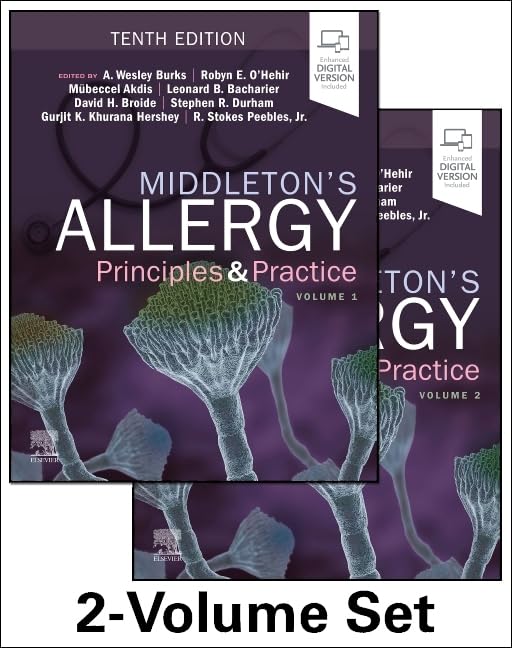
Description
Middletons Allergy 2Volume Set Principles and Practice 2026
Middleton’s Allergy 2-Volume Set: Principles and Practice 2026
Product details
- Publisher : Elsevier
- Publication date : April 23, 2026
- Edition : 10th
- Language : English
- Print length : 1840 pages
- ISBN-10 : 0443249725
- ISBN-13 : 978-0443249723 9780443249723
Middleton’s Allergy 2-Volume Set Principles and Practice 2026
In the world of allergy and immunology, one reference has consistently stood above the rest. Middleton’s Allergy 2-Volume Set Principles and Practice 2026 is the definitive resource for understanding allergic diseases — from the molecular mechanisms that drive them to the clinical strategies used to manage them. This latest edition brings together cutting-edge science and real-world clinical practice in a way that no other allergy reference currently matches.
Whether you are an immunology trainee, a rheumatologist managing autoimmune overlap conditions, or a clinician looking to deepen your allergy knowledge, this two-volume set delivers the authority and depth your practice demands.
Why Middleton’s Allergy Principles and Practice 2026 Is the Definitive Reference in Its Field
Allergic and immunological diseases have grown dramatically in prevalence and clinical complexity over the past two decades. Managing asthma, anaphylaxis, drug hypersensitivity, food allergies, and autoimmune conditions requires a level of mechanistic understanding that goes well beyond surface-level clinical guides.
Middleton’s Allergy has been the gold standard in this space for decades, and the 2026 edition builds on that legacy. Among the most comprehensive medical textbooks in immunology and allergy, this two-volume set is trusted by allergists, immunologists, pulmonologists, rheumatologists, and general physicians worldwide.
What Does This Two-Volume Set Cover?
The scope of this reference is genuinely impressive. Both volumes together cover the entire landscape of allergy and clinical immunology, organized from basic science principles through to practical disease management.
Volume 1 — Principles — covers:
- Immunological foundations — innate and adaptive immunity, cytokine biology, and immune cell function
- Mechanisms of allergic disease — IgE-mediated hypersensitivity, mast cell and basophil biology, and allergic inflammation
- Genetics and epidemiology — hereditary factors in atopic disease and population-level allergy trends
- Allergens — aeroallergens, food allergens, occupational allergens, and insect venoms
- Diagnostic principles — skin testing, specific IgE assays, provocation testing, and component-resolved diagnostics
Volume 2 — Practice — covers:
- Asthma — pathophysiology, classification, pharmacotherapy, and biologics
- Allergic rhinitis and sinusitis — diagnosis, stepwise management, and immunotherapy
- Food allergy and anaphylaxis — risk stratification, emergency management, and oral immunotherapy
- Drug hypersensitivity — classification, evaluation, and desensitization protocols
- Atopic dermatitis and urticaria — current treatment algorithms and emerging therapies
- Autoimmune and rheumatological overlap — immune dysregulation in connective tissue diseases and vasculitis
- Immunodeficiency states — primary and secondary immune deficiencies and their management
- Occupational allergy — workplace-triggered conditions and medicolegal considerations
This extraordinary breadth makes it one of the most complete clinical medicine books available in the allergy and immunology space, complementing the systemic knowledge built through anatomy books and other core references.
Who Should Use This Book?
Given the breadth of its content, this two-volume set serves a remarkably wide clinical audience:
- Allergy and immunology trainees preparing for subspecialty board examinations and clinical fellowship programs
- Rheumatology students and trainees who manage patients with autoimmune and hypersensitivity conditions regularly
- Pulmonologists and respiratory physicians dealing with asthma, occupational lung disease, and hypersensitivity pneumonitis
- MBBS students and postgraduate trainees building a strong immunology foundation for licensing exams
- General physicians and internists who encounter allergic conditions across a broad patient population
- Orthopedic trainees who manage patients with drug allergies, NSAID hypersensitivity, and perioperative anaphylaxis risk
Learners using physiotherapy books for managing patients with inflammatory and autoimmune musculoskeletal conditions will also find the immunological mechanisms chapters highly relevant to their clinical practice.
Clinical and Educational Benefits
What makes Middleton’s Allergy truly exceptional is how it connects laboratory science to bedside decision-making. Every mechanistic concept is followed through to its clinical implications — making this not just a reference book but a genuine educational journey through modern immunology.
For rheumatology trainees especially, the content on immune dysregulation, cytokine pathways, and biologic therapies directly overlaps with the pharmacological principles used in managing rheumatoid arthritis, lupus, and vasculitis. This is one of the few healthcare education resources that bridges allergy and rheumatology with such clinical precision.
The drug hypersensitivity and perioperative allergy chapters are equally valuable for surgical trainees and anesthesiologists, making this a strong companion to surgery books and orthopedic surgery books used in perioperative planning.
Practical Learning Advantages
Despite its comprehensive scope, Middleton’s Allergy is organized and written in a way that makes it genuinely practical to use — whether for deep study, quick clinical reference, or exam preparation.
Practical advantages include:
- Expert-authored chapters written by leading allergists and immunologists from major academic centers
- Evidence-based management algorithms for common and complex allergic conditions
- Detailed coverage of biologic therapies including anti-IgE, anti-IL-4, anti-IL-5, and anti-IL-13 agents
- Updated anaphylaxis management protocols aligned with current international guidelines
- High-quality figures and tables summarizing diagnostic criteria and treatment pathways
- Comprehensive drug desensitization protocols for oncology, antibiotic, and NSAID hypersensitivity
These features place it firmly among the most trusted medical textbooks for allergy and immunology training — a resource that works equally well for MBBS books level learning and advanced subspecialty preparation.
Key Features at a Glance
| Feature | Detail |
|---|---|
| Edition | 2026 Updated Edition |
| Format | 2-Volume Set |
| Subject Focus | Allergy, clinical immunology, and hypersensitivity |
| Audience | Allergists, rheumatologists, pulmonologists, general physicians |
| Content Style | Principles-based with full clinical practice coverage |
| Special Sections | Biologics, anaphylaxis, drug desensitization, autoimmune overlap |
Frequently Asked Questions (FAQ)
Q: Is this set suitable for allergy and immunology board examination preparation?
Yes. The comprehensive coverage of both basic principles and clinical practice makes it an authoritative resource for ABAI board examinations and equivalent international certifications.
Q: Can rheumatology trainees benefit from this two-volume set?
Absolutely. The autoimmune overlap, cytokine biology, and biologic therapy chapters are directly relevant to rheumatology training and are not covered at this depth in most standalone rheumatology references.
Q: Is the 2026 edition significantly updated from the previous edition?
Yes. The 2026 edition includes expanded coverage of biologic and targeted therapies, updated anaphylaxis and food allergy guidelines, revised drug hypersensitivity protocols, and new chapters on emerging immunological concepts.
Q: Is this set accessible for MBBS students or is it too advanced?
The foundational immunology chapters in Volume 1 are accessible to advanced MBBS students and postgraduate trainees, while Volume 2 is oriented toward clinicians and subspecialty trainees in active practice.
Q: Does it cover occupational allergy and environmental conditions?
Yes. Occupational allergy, environmental allergens, and workplace-triggered respiratory and skin conditions are covered thoroughly in dedicated chapters.
Final Verdict — Order Middleton’s Allergy 2-Volume Set Principles and Practice 2026 Today
For any clinician or trainee who takes allergy and immunology seriously, Middleton’s Allergy 2-Volume Set Principles and Practice 2026 is simply the most authoritative resource available. It combines scientific rigor with clinical practicality in a way that no shorter reference can replicate — and its coverage of autoimmune, rheumatological, and surgical allergy topics makes it valuable well beyond the allergy clinic.
Add it to your professional library alongside your most trusted medical textbooks and healthcare education resources, and invest in a reference that will serve your clinical career at every stage.
Order your copy of Middleton’s Allergy 2026 today and experience the gold standard in allergy and immunology education


Reviews
There are no reviews yet.