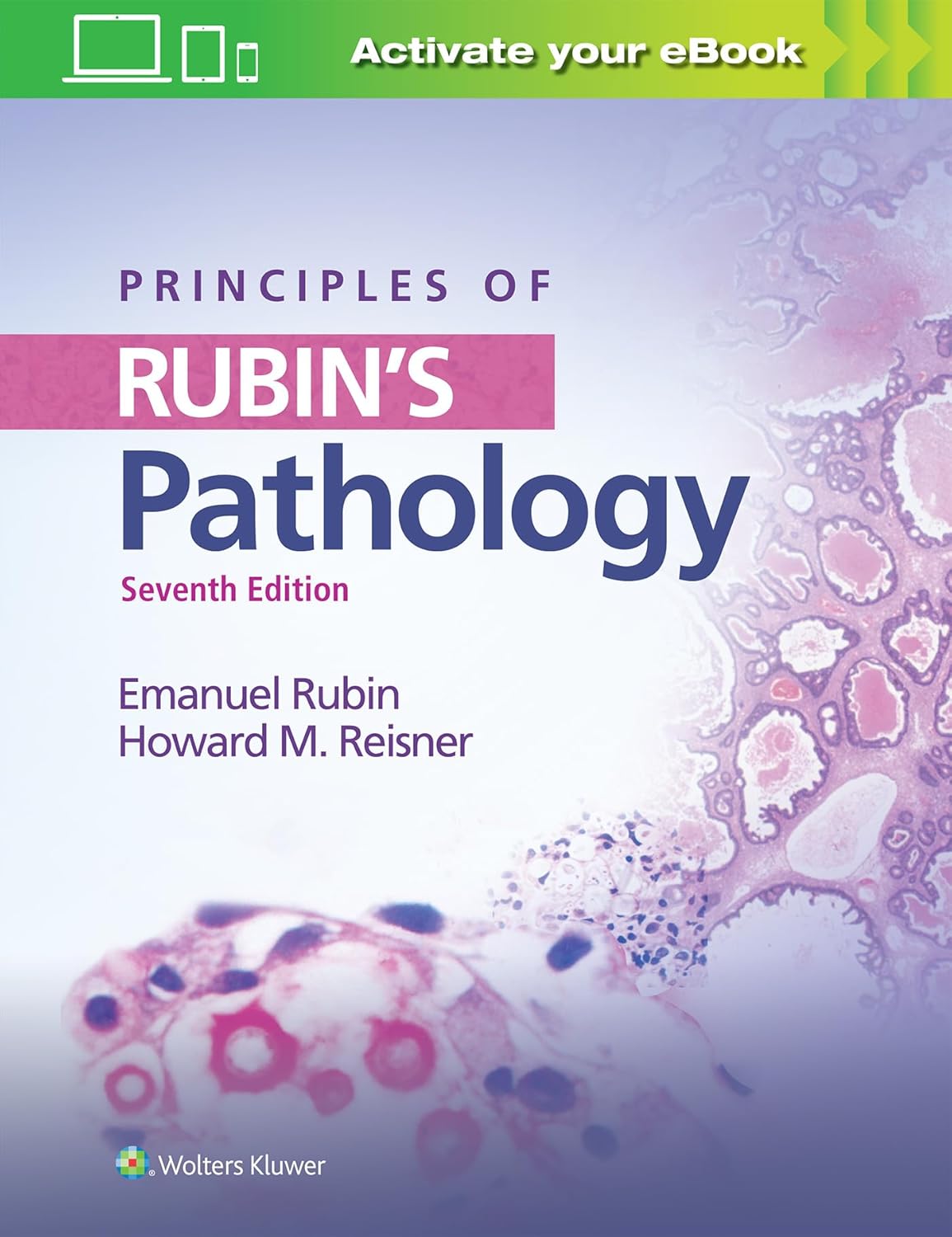
Description
Principles of Rubins Pathology 8th Edition
Product details
Publisher : LWW
Publication date : November 3, 2018
Edition : Seventh
Language : English
Print length : 968 pages
ISBN-10 : 1496350324
ISBN-13 : 978-1496350329
Principles of Rubins Pathology 8th Edition – Pathology Explained From First Principles to Clinical Practice
Not all pathology textbooks are created equal — and Principles of Rubin’s Pathology 8th Edition proves that with every chapter. Built around a mechanistic, first-principles approach to understanding disease, this book goes beyond surface-level descriptions to explain the molecular and cellular basis of pathology in a way that genuinely builds lasting medical knowledge. Whether you are encountering pathology for the first time or deepening your understanding ahead of postgraduate examinations, this edition delivers a reading experience that is both intellectually rigorous and genuinely accessible.
For students and clinicians looking for more than a facts-only pathology text, Principles of Rubin’s Pathology stands confidently among the most educationally complete medical textbooks available in the field today.
What Does Principles of Rubin’s Pathology 8th Edition Cover?
The 8th edition provides thorough coverage of both general pathology principles and systemic organ pathology, with each topic presented in a logically structured way that moves from mechanism to morphology to clinical consequence. The content is broad enough to cover the full MBBS and postgraduate pathology syllabus, yet focused enough to keep every chapter clinically purposeful.
Core content includes:
- Cell biology of disease — cell injury, adaptation, necrosis, apoptosis, and subcellular pathology
- Inflammation and repair — acute and chronic inflammation, granuloma formation, fibrosis, and tissue regeneration
- Immunopathology — hypersensitivity reactions, autoimmune diseases, immunodeficiency, and transplant pathology
- Neoplasia — molecular mechanisms of cancer, hallmarks of malignancy, tumour classification, invasion, and metastasis
- Haemodynamic disorders — thrombosis, embolism, infarction, haemorrhage, and shock
- Genetic and developmental disease — chromosomal disorders, Mendelian inheritance patterns, and congenital anomalies
- Environmental and nutritional pathology
- Systemic pathology — cardiovascular, respiratory, renal, hepatic, gastrointestinal, endocrine, and reproductive systems
- Musculoskeletal pathology — bone tumours, metabolic bone disease, degenerative and inflammatory joint diseases, crystal arthropathies, muscle disorders, and soft tissue pathology, with strong relevance for those using orthopedic surgery books
- Nervous system and haematological pathology
The musculoskeletal and immune pathology sections are particularly detailed — covering the molecular mechanisms behind rheumatoid synovitis, the crystal deposition processes in gout and pseudogout, osteoporosis, bone tumour biology, and connective tissue disorders in a way that directly supports rheumatology and orthopedic trainees.
Who Should Use Principles of Rubin’s Pathology?
This book serves a broad audience across medical and allied health education. It is an excellent choice for:
- MBBS students who want a pathology textbook that explains mechanisms rather than just listing facts — it complements your core MBBS books and provides the deeper understanding that distinguishes strong examination performance
- Physiotherapy students who need a solid pathological foundation for the musculoskeletal, inflammatory, and neuromuscular conditions they treat clinically — it works naturally alongside your physiotherapy books
- Orthopedic trainees looking for detailed bone, joint, and soft tissue pathology to complement their orthopedic surgery books and postgraduate examination preparation
- Rheumatology students and residents building mechanistic understanding of autoimmune joint disease, crystal arthropathy, vasculitis, and systemic connective tissue disorders
- Doctors preparing for USMLE, FCPS, MRCP, or FRCS who want a pathology reference that explains why diseases behave the way they do — knowledge that holds up under the clinical reasoning demands of modern licensing examinations
- Anyone investing in a comprehensive, intellectually grounded library of healthcare education resources
Clinical and Educational Benefits
First-Principles Explanations That Build Lasting Understanding
The hallmark of Principles of Rubin’s Pathology is its commitment to explanation over enumeration. Rather than presenting pathological findings as a list of facts to memorise, this book explains the underlying molecular and cellular events that produce those findings — and then connects those mechanisms to clinical presentation, investigation, and outcome.
That depth of explanation makes it an outstanding complement to both anatomy books and surgery books, where understanding the pathological process behind a clinical scenario strengthens decision-making at every level of training and practice.
Outstanding Visual Support Throughout
The 8th edition is visually rich — full-colour histopathology images, gross specimen photographs, schematic diagrams, and concept illustrations are used throughout every chapter. For pathology, where visual pattern recognition is central to both learning and examination, this visual quality is essential. The images are carefully selected to reinforce the mechanistic explanations in the text rather than simply illustrating conditions in isolation.
Particularly Strong for Musculoskeletal and Immune Pathology
Rheumatology and orthopedic trainees will find the depth of musculoskeletal coverage exceptional. From the molecular mechanisms of inflammatory synovitis to the classification and clinical behaviour of primary bone tumours, from crystal-induced inflammation to the pathological basis of osteoporosis — this edition covers these topics with the kind of mechanistic clarity that makes clinical understanding genuinely deep and durable.
Practical Learning Advantages
Despite its intellectual depth, the 8th edition is designed to support efficient study and targeted revision. Key practical strengths include:
- Full-colour histopathology and gross pathology images integrated throughout all chapters
- Key concept summaries and clinical correlation boxes for rapid review of core points
- Consistent chapter structure — mechanism, morphology, clinical features, diagnosis, and prognosis
- Updated 8th edition content reflecting current advances in molecular oncology, immunopathology, and precision medicine
- Review questions and self-assessment material to support examination preparation
- Available in print and digital formats for flexible study across different environments
Key Features of Principles of Rubin’s Pathology 8th Edition
- ✅ Comprehensive general and systemic pathology from a first-principles, mechanistic perspective
- ✅ Updated 8th edition content including molecular oncology, immunopathology, and current clinical advances
- ✅ Full-colour histopathology and gross pathology image library throughout
- ✅ Consistent chapter structure linking mechanism to morphology to clinical consequence
- ✅ Detailed musculoskeletal, immune, and connective tissue pathology for specialty training
- ✅ Review questions and self-assessment material for examination preparation
- ✅ Ideal companion to clinical medicine books and MBBS books at all levels of training
- ✅ Recommended across MBBS, postgraduate, and allied health programmes internationally
Frequently Asked Questions (FAQ)
How does Principles of Rubin’s Pathology compare to Robbins?
Both are highly respected pathology textbooks, but they take somewhat different approaches. Robbins is globally dominant in medical education and is particularly aligned with USMLE preparation. Rubin’s is known for its first-principles mechanistic approach — it often explains the molecular and cellular basis of disease in greater conceptual depth. Many students and educators find that Rubin’s builds a more durable understanding of pathology that holds up better under the clinical reasoning demands of modern examinations and practice.
Is this book appropriate for MBBS students?
Yes, absolutely. The 8th edition is well-suited for MBBS students who want to understand pathology deeply rather than simply memorise it. The clear writing, logical structure, and visual support make it accessible to undergraduate learners, while the mechanistic depth provides the understanding that produces strong examination performance and long-term clinical competence.
Is Principles of Rubin’s Pathology useful for physiotherapy students?
Yes. The musculoskeletal pathology, inflammation and repair, and neuromuscular disease sections are directly relevant to physiotherapy training. Understanding the pathological mechanisms behind the conditions physiotherapists treat strengthens both clinical assessment and patient communication. Used alongside your physiotherapy books, it provides the mechanistic pathological grounding that elevates clinical reasoning.
How does this book support orthopedic and rheumatology training?
The musculoskeletal pathology chapter provides in-depth mechanistic coverage of inflammatory arthritis, degenerative joint disease, crystal arthropathies, bone tumours, and metabolic bone disease. For orthopedic trainees, it complements orthopedic surgery books by explaining the pathological basis of conditions encountered in surgical practice. For rheumatology trainees, the immunopathology and connective tissue disease sections are equally strong, supporting a mechanistic understanding of complex autoimmune conditions.
Is the 8th edition worth upgrading to?
Yes. The 8th edition includes updated content across molecular oncology, immunopathology, infectious disease, and precision medicine, along with revised images and refreshed clinical correlations throughout. For anyone building a new pathology library or updating an existing one, the 8th edition represents the most current and complete version of this excellent resource.
Final Verdict – Why Principles of Rubin’s Pathology 8th Edition Belongs in Every Serious Medical Library
The best pathology education leaves you not just knowing disease, but understanding it — and that is precisely what Principles of Rubin’s Pathology 8th Edition achieves. Through first-principles explanation, outstanding visual support, and consistent clinical relevance, it builds the kind of pathological understanding that serves you throughout your entire medical career rather than just carrying you through a single examination.
Whether you are completing your foundational MBBS books, building a career-long collection of healthcare education resources, or looking for pathological depth that complements your surgery books and clinical medicine books — this edition is a worthy and lasting investment in your medical education.
Order Principles of Rubin’s Pathology 8th Edition today and build a pathological understanding that goes deeper than any exam — and lasts longer than any revision


Reviews
There are no reviews yet.