Description
Product details
- ASIN : B00AQGJEUK
- Publisher : Lippincott Williams & Wilkins
- Publication date : December 18, 2012
- Edition : 4th
- Language : English
- Screen Reader : Supported
- Enhanced typesetting : Enabled
- Word Wise : Not Enabled
- Print length : 373 pages
- ISBN-13 : 978-1469824314
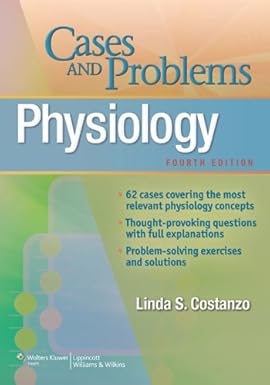
Physiology Cases and Problems 4th Edition – Learn Physiology Through Real Clinical Scenarios and Problem-Based Practice
Reading physiology theory is one thing — applying it under clinical pressure is another. That gap between knowing and doing is exactly what the Physiology Cases and Problems 4th Edition by Dr. Linda Costanzo is designed to close. Rather than presenting physiology as a set of facts to memorise, this book teaches it through structured clinical cases and problem-solving exercises that mirror the challenges of real patient care. It is one of the most effective active-learning tools available for medical students who want to move from passive reading to genuine clinical reasoning.
Whether you are preparing for USMLE Step 1, refreshing your applied physiology knowledge, or supplementing a core textbook with case-based practice, this fourth edition delivers exactly the kind of problem-solving experience that makes physiology stick.
What Does Physiology Cases and Problems 4th Edition Cover?
This book is organised around clinical cases that test and reinforce physiological understanding across all major body systems. Each case presents a patient scenario, followed by progressively challenging questions and detailed, explanatory answers — building both knowledge and clinical thinking simultaneously.
Systems and topics covered include:
- Neurophysiology — sensory and motor pathways, reflexes, and autonomic control
- Cardiovascular physiology — cardiac function, pressure-volume relationships, and circulatory regulation
- Respiratory physiology — ventilation-perfusion, gas exchange, and acid-base disorders
- Renal physiology — nephron function, fluid balance, and electrolyte disorders
- Gastrointestinal physiology — secretion, absorption, and gut motility disorders
- Endocrine physiology — hormonal disorders, feedback regulation, and metabolic imbalances
- Musculoskeletal physiology — skeletal muscle mechanics, neuromuscular disorders, and motor dysfunction
- Acid-base physiology — clinical disturbances and compensation mechanisms
The musculoskeletal and neuromuscular physiology cases — covering conditions like muscle weakness, joint dysfunction, and inflammatory musculoskeletal disorders — are particularly valuable when studied alongside orthopedic surgery books to build a clinically integrated understanding of the musculoskeletal system.
Who Should Use This Book
MBBS and Undergraduate Medical Students
This is one of the most impactful additions to any collection of MBBS books. It bridges the critical gap between theoretical physiology and applied clinical thinking — making it ideal for students in their pre-clinical years who want to start thinking like clinicians from day one, and for those in their clinical years who need to reinforce their physiological foundations.
Orthopedic and Rheumatology Trainees
Applied physiology cases involving musculoskeletal disorders, inflammatory joint diseases, bone metabolism, neuromuscular dysfunction, and connective tissue physiology make this book directly relevant to trainees in both orthopedics and rheumatology. Used alongside anatomy books and clinical medicine books, it strengthens the ability to reason through complex musculoskeletal presentations with physiological precision.
Physiotherapy Students
Among the most practically useful physiotherapy books for applied learning, this edition challenges physiotherapy students to think through the physiological basis of the conditions they will treat — including muscle weakness, reflex abnormalities, autonomic dysfunction, and exercise intolerance — in a format that closely mirrors clinical decision-making.
Practicing Doctors and Healthcare Educators
For clinicians who want to sharpen their physiological reasoning through case-based review, or educators looking for a problem-based teaching resource, this book is an excellent choice. It fits naturally into case-based healthcare education resources used in medical schools and postgraduate clinical training environments.
Clinical and Educational Benefits
What makes Physiology Cases and Problems 4th Edition genuinely exceptional among problem-based medical textbooks is the quality of its explanations. The answers to each case question are not just correct — they are educational. They explain the reasoning step by step, clarify common misconceptions, and reinforce the underlying physiological principles in a way that builds lasting understanding rather than short-term recall.
Furthermore, by presenting physiology through the lens of patient problems, this book naturally trains students to think in the integrated, system-linking way that both licensing examinations and clinical practice demand. It is the difference between knowing a fact and knowing how to use it.
Key Features of This Edition
- ✅ Case-based format — physiology learned through real clinical problem-solving
- ✅ Progressive questioning — cases build in complexity to develop deeper reasoning
- ✅ Detailed explanatory answers that teach, not just confirm
- ✅ Full coverage of all major physiological systems with clinical case scenarios
- ✅ Strong emphasis on acid-base disorders, cardiovascular regulation, and renal physiology
- ✅ Ideal USMLE Step 1 physiology preparation companion
- ✅ Outstanding supplement to surgery books and core clinical references
Practical Learning Advantages
The most significant practical advantage of this book is that it makes self-testing active and meaningful. Rather than re-reading notes or highlighting text, students work through genuine clinical challenges — which research consistently shows leads to better retention and stronger examination performance.
When combined with a core physiology text and anatomy books, this problem-based approach creates a complete learning cycle: understand the concept, visualise the structure, then apply both to a real clinical problem. That three-step loop is one of the most effective strategies available to medical students preparing for both written and clinical assessments.
Additionally, for students who are working through orthopedic surgery books alongside their physiology revision, the musculoskeletal and neuromuscular case scenarios in this edition provide the physiological reasoning layer that surgical texts alone do not offer — deepening understanding of why certain conditions present and progress the way they do.
Frequently Asked Questions (FAQ)
Is Physiology Cases and Problems 4th Edition suitable for MBBS students?
Absolutely. It is most effective for second-year students who have completed their introductory physiology course and want to test and deepen their understanding through clinical application. It is also highly valuable for students preparing for licensing examinations like USMLE Step 1 or PLAB.
Can this book be used as a standalone physiology resource?
It is most effective when used alongside a primary physiology textbook such as Costanzo Physiology or BRS Physiology. The cases assume foundational physiological knowledge and are designed to apply and test that knowledge rather than introduce it from scratch.
Is this book useful for rheumatology and orthopedic trainees?
Yes. The cases involving musculoskeletal physiology, neuromuscular disorders, inflammatory joint conditions, and connective tissue disease are directly relevant to both specialties — helping trainees reason through the physiological underpinnings of the conditions they manage clinically.
How does the 4th edition differ from previous editions?
The 4th edition features updated clinical cases, revised explanatory answers reflecting current medical understanding, new case scenarios in endocrinology and renal physiology, and improved formatting — ensuring the content is current, accurate, and aligned with modern clinical and examination standards.
Can physiotherapy students benefit from this problem-based approach?
Definitely. The case-based format helps physiotherapy students apply their physiological knowledge to clinical presentations involving muscle dysfunction, motor control abnormalities, autonomic disorders, and exercise physiology — all of which are central to physiotherapy assessment and treatment planning.
Order Physiology Cases and Problems 4th Edition and Start Thinking Like a Clinician Today
Theory without application only takes you so far. The Physiology Cases and Problems 4th Edition is the book that turns your physiological knowledge into genuine clinical thinking — challenging you with real patient scenarios, guiding you through expert reasoning, and building the kind of integrative understanding that defines confident, competent medical practice.
It is one of the most practically valuable problem-based medical textbooks available, and no serious medical student’s library is truly complete without it. Whether you use it for exam preparation, self-assessment, or clinical reasoning practice, it will consistently sharpen your thinking and deepen your understanding.
Add it to your cart today and explore our full range of MBBS books, clinical medicine books, and healthcare education resources — because the best way to learn medicine is to practise thinking it through.
Reviews
There are no reviews yet.