Description
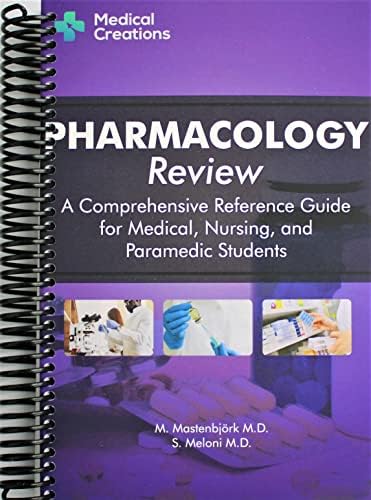
Pharmacology Review A Comprehensive Reference Guide for Medical Nursing and Paramedic Students
Product details
ASIN : B0CW3S4SDM
Publisher : Generic
Publication date : February 7, 2021
Edition : Medical Creations
Language : English
Print length : 326 pages
ISBN-13 : 978-1734741315
Pharmacology Review – A Comprehensive Reference Guide for Medical, Nursing, and Paramedic Students
Healthcare education works best when knowledge is shared across disciplines — and that is exactly the philosophy behind Pharmacology Review: A Comprehensive Reference Guide for Medical, Nursing, and Paramedic Students. Unlike pharmacology resources written exclusively for one professional group, this guide is designed to serve the full spectrum of healthcare learners: medical students who need a solid pharmacological foundation, nursing students who need drug administration and safety knowledge, and paramedic students who need rapid, action-oriented drug information for emergency settings. One book, one consistent pharmacology framework — built for the entire healthcare team.
Comprehensive in coverage yet accessible in approach, this reference guide delivers the drug knowledge every healthcare student needs — regardless of their professional pathway — in a clear, organised, and clinically grounded format.
What Does This Pharmacology Review Comprehensive Reference Guide Cover?
This guide covers all major drug classes with a breadth and clinical relevance that makes it genuinely useful across medical, nursing, and paramedic education. The content is organised to support both structured revision and rapid clinical reference, making it equally effective in a study session and on a clinical shift.
Key pharmacological areas covered include:
- Principles of pharmacology — pharmacokinetics, pharmacodynamics, drug metabolism, and adverse reactions
- Autonomic pharmacology — adrenergic and cholinergic agents, neuromuscular blockers, and autonomic antagonists
- Cardiovascular pharmacology — antihypertensives, antiarrhythmics, anticoagulants, antiplatelets, and heart failure drugs
- Respiratory pharmacology — bronchodilators, inhaled corticosteroids, oxygen therapy, and antihistamines
- Central nervous system pharmacology — analgesics, sedatives, antidepressants, antiepileptics, and antipsychotics
- Musculoskeletal pharmacology — NSAIDs, corticosteroids, DMARDs, biologic agents, muscle relaxants, and gout drugs
- Emergency and paramedic pharmacology — resuscitation drugs, emergency analgesics, and acute care medications
- Endocrine pharmacology — insulin, oral antidiabetics, thyroid agents, and adrenal drugs
- Antimicrobial pharmacology — antibiotic classes, antifungals, antivirals, and resistance principles
- Drug safety, interactions, adverse effect profiles, and clinical monitoring essentials
The musculoskeletal pharmacology section — covering NSAIDs, corticosteroid therapy, DMARDs, biologic treatments, and analgesic management — makes this a genuinely useful cross-disciplinary companion to orthopedic surgery books for students and trainees in surgical, musculoskeletal, and rehabilitation clinical settings.
Who Should Use This Book?
MBBS and Undergraduate Medical Students
Among the most multidisciplinary titles in the range of MBBS books and clinical pharmacology resources, this guide is particularly useful for medical students who want to understand drug management from the perspective of the entire healthcare team — not just the prescriber. That broader perspective builds more collaborative, patient-centred clinical thinking from early in medical training.
Orthopedic and Rheumatology Trainees
For trainees working in multidisciplinary orthopedic and rheumatology teams — where nurses, physiotherapists, and paramedics all play active roles in patient pharmacological management — this reference guide bridges professional knowledge gaps effectively. The musculoskeletal drug content complements anatomy books and clinical medicine books, supporting a comprehensive and team-oriented approach to drug knowledge in specialty practice.
Physiotherapy Students and Clinicians
Among the most cross-professionally useful physiotherapy books and pharmacology references, this guide provides physiotherapy students and practitioners with a clear, comprehensive overview of the drug classes most relevant to their patient populations — including analgesics, anti-inflammatory agents, muscle relaxants, cardiovascular drugs, and emergency medications encountered in rehabilitation and acute settings.
Practicing Doctors, Nurses, Paramedics, and Healthcare Educators
This guide is one of the few pharmacology resources that serves the full healthcare education community. For educators building interprofessional pharmacology programmes, and for clinicians in multidisciplinary teams who want a shared pharmacological reference, this book integrates naturally into any set of healthcare education resources used across medical, nursing, and allied health training programmes.
Clinical and Educational Benefits
What genuinely distinguishes this Pharmacology Review Comprehensive Reference Guide from specialist-only medical textbooks is its deliberately interprofessional design. Drug knowledge presented from multiple clinical perspectives — prescribing, administration, monitoring, and emergency use — creates a more complete and practically useful pharmacological understanding than single-profession texts can achieve. Students who understand how their colleagues use the same drugs develop stronger communication skills, safer prescribing habits, and more effective multidisciplinary working from the very beginning of their clinical careers.
Furthermore, the inclusion of paramedic and emergency pharmacology content is a genuinely rare feature in a reference guide of this breadth. It makes this book particularly valuable for students and clinicians whose work spans pre-hospital, acute, and rehabilitation care environments.
Key Features of This Guide
- ✅ Comprehensive drug coverage across medical, nursing, and paramedic pharmacology curricula
- ✅ Interprofessional design — useful for every member of the healthcare team
- ✅ Emergency and resuscitation pharmacology included — rare in generalist pharmacology guides
- ✅ Drug safety, interaction profiles, and monitoring essentials integrated throughout
- ✅ Clear, consistent drug class structure for fast navigation and efficient revision
- ✅ Strong musculoskeletal, cardiovascular, and CNS pharmacology coverage
- ✅ Practical clinical reference companion to surgery books and ward-based clinical resources
Practical Learning Advantages
One of the most distinctive practical advantages of this book is its usefulness across an entire clinical placement — regardless of which ward, department, or emergency setting a student or trainee is working in. Because it covers medical, nursing, and paramedic pharmacology in a single volume, it functions as a consistent reference point across different clinical environments and team structures.
When used alongside anatomy books and a core pharmacology text, this guide adds a clinical-team dimension that single-discipline pharmacology resources simply cannot provide. Understanding how drugs are used by different team members — from prescription to administration to emergency resuscitation — produces a more integrated and clinically confident practitioner.
Furthermore, for students who are concurrently working through orthopedic surgery books and entering musculoskeletal surgical or rehabilitation settings, the practical drug coverage of analgesics, anticoagulants, anti-inflammatory protocols, and perioperative medications in this guide supports the pharmacological knowledge that multidisciplinary surgical teams rely on across all professional roles.
Frequently Asked Questions (FAQ)
Is this guide suitable for MBBS medical students?
Absolutely. While it covers nursing and paramedic pharmacology as well, the medical pharmacology content is comprehensive and clinically grounded. MBBS students benefit from the additional interprofessional perspective, which prepares them for team-based clinical practice from early in their training.
Does the guide cover emergency pharmacology in enough depth for paramedic students?
Yes. The emergency and paramedic pharmacology sections cover resuscitation drugs, acute care analgesics, emergency cardiovascular agents, and critical monitoring essentials in sufficient clinical depth for paramedic students at both undergraduate and post-registration levels.
Is this book useful for rheumatology and orthopedic trainees?
Yes. The musculoskeletal pharmacology coverage — including NSAIDs, corticosteroids, DMARDs, biologic agents, and gout management — is clinically relevant for both specialties. Additionally, the interprofessional format helps trainees understand how their nursing and allied health colleagues use the same medications, which improves team communication and patient safety.
Can physiotherapy students use this as their primary pharmacology reference?
Yes, particularly for understanding the full range of drugs encountered across their patient caseloads. The analgesic, anti-inflammatory, cardiovascular, and emergency pharmacology sections are all directly relevant to physiotherapy clinical practice in both rehabilitation and acute settings.
How does this guide differ from single-profession pharmacology textbooks?
Single-profession pharmacology books are written exclusively for prescribers, nurses, or paramedics. This guide presents pharmacology from all three perspectives in one resource — making it uniquely useful for interprofessional education programmes, multidisciplinary clinical teams, and students who want a broader understanding of how drugs function across the entire care pathway.
Order Pharmacology Review: A Comprehensive Reference Guide for Medical, Nursing, and Paramedic Students Today
Whether you are a medical student building clinical pharmacology foundations, a physiotherapy student understanding the drug context of your patients’ care, or a trainee in orthopedics or rheumatology working within a multidisciplinary team, this Pharmacology Review Comprehensive Reference Guide delivers the breadth, clinical relevance, and interprofessional perspective that modern healthcare education demands.
It stands as one of the most genuinely cross-professional pharmacology medical textbooks available — and an indispensable reference for any healthcare student who wants drug knowledge that works across the entire clinical team.
Add it to your cart today and explore our full range of MBBS books, clinical medicine books, and healthcare education resources — because great patient care is always a team effort, and great drug knowledge should be too.
Reviews
There are no reviews yet.