Description
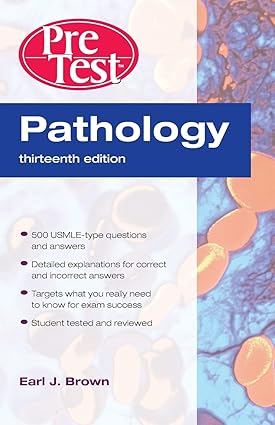
Pathology PreTest Self Assessment and Review 13th Edition
Product details
- Publisher : McGraw Hill / Medical
- Publication date : March 11, 2010
- Edition : 13th
- Language : English
- Print length : 612 pages
- ISBN-10 : 0071623493
- ISBN-13 : 978-0071623490 9780071623490
Pathology PreTest Self Assessment and Review 13th Edition — Know Your Pathology Before the Exam Tests You
Pathology sits at the heart of medical understanding. It is the subject that explains why disease happens, how it progresses, and what it looks like at the cellular and tissue level. The Pathology PreTest Self Assessment and Review 13th Edition gives you a focused, question-driven way to test and reinforce your pathology knowledge — helping you walk into your USMLE Step 1 exam, or any pathology assessment, with genuine confidence.
If you have been studying pathology through lectures and textbooks, this is the book that tells you honestly how much of it has actually stuck.
What Is Pathology PreTest Self Assessment and Review 13th Edition?
Part of the respected and long-running McGraw-Hill PreTest series, this book is one of the most trusted medical textbooks available for pathology self-assessment at the preclinical level. Faculty with direct knowledge of current medical licensing standards have reviewed and refined each edition to ensure close alignment with the USMLE Step 1 content blueprint.
The 13th edition continues that standard — delivering a well-constructed question bank that tests pathological concepts at the right depth, with explanations that genuinely teach rather than simply confirm correct answers.
What Does This Book Cover?
The book covers the full scope of general and systemic pathology tested in preclinical medical education and on USMLE Step 1. Topics include:
- General pathology — cell injury, inflammation, repair, and neoplasia
- Cardiovascular pathology — atherosclerosis, cardiomyopathies, valvular disease, and congenital heart defects
- Pulmonary pathology — pneumonias, obstructive and restrictive lung diseases, and lung tumors
- Gastrointestinal pathology — peptic ulcer disease, inflammatory bowel disease, and GI malignancies
- Hepatobiliary and pancreatic pathology
- Renal pathology — glomerulonephritis, nephrotic syndrome, and renal tumors
- Hematopathology — anemias, leukemias, lymphomas, and bleeding disorders
- Musculoskeletal and bone pathology — osteosarcoma, osteoporosis, Paget’s disease, and joint disorders
- Neuropathology — CNS tumors, demyelinating diseases, and neurodegenerative conditions
- Rheumatological and autoimmune pathology — rheumatoid arthritis, systemic lupus erythematosus, and vasculitis
- Endocrine and reproductive pathology
- Infectious disease pathology and immunopathology
The musculoskeletal, rheumatological, and bone pathology sections make this especially relevant when studied alongside orthopedic surgery books and clinical medicine books for a more integrated understanding of disease.
Who Should Use This Book?
For MBBS Students in Preclinical Years
First- and second-year medical students approaching their pathology examinations or preparing for USMLE Step 1 will find this book an essential companion to their core MBBS books. The active question-and-answer format accelerates retention far more effectively than passive re-reading.
For Physiotherapy Students
Physiotherapy students study pathology to understand the disease processes underlying the conditions they treat — from musculoskeletal degeneration to neurological injury. This book complements physiotherapy books by offering structured self-assessment across the pathological topics most relevant to rehabilitation practice.
For Orthopedic and Rheumatology Trainees
Postgraduate trainees in orthopedics and rheumatology will find the bone, joint, and autoimmune pathology sections particularly valuable for board exam preparation and foundational revision. It pairs naturally with orthopedic surgery books and dedicated rheumatology references to build a complete picture of disease from microscopic origin to clinical presentation.
For Doctors Revisiting Core Science
Clinicians returning to basic pathology for teaching roles, licensing renewal, or subspecialty examinations will appreciate the concise, self-directed format. Strong pathology knowledge continues to inform better clinical decision-making at every stage of a medical career.
Clinical and Educational Benefits
The PreTest format is built around one of the most evidence-supported learning strategies available — active recall. Rather than reading passively through dense pathology chapters, you engage with questions that challenge your understanding and force genuine cognitive effort.
This approach consistently produces better outcomes than re-reading alone because it identifies exactly where your knowledge breaks down — before the exam does.
Working through this book will help you:
- Pinpoint specific knowledge gaps across all major organ systems
- Understand disease mechanisms at a level that supports clinical reasoning
- Connect pathological findings with the presentations you encounter in clinical medicine books
- Build familiarity with USMLE-style question formats and clinical vignette structures
- Strengthen your understanding of surgical pathology to complement your surgery books studies
Practical Learning Advantages
One of the most effective ways to use this book is as both a diagnostic and a revision tool. Start each organ system by attempting the relevant questions without preparation — your results will immediately show you where to focus your study time. Then return to those questions after targeted revision to measure real improvement.
This approach is far more time-efficient than working through an entire textbook chapter by chapter, especially during the high-pressure weeks before an exam.
The book also integrates naturally with anatomy books when studying the structural basis of pathological changes, and forms a strong part of any healthcare education resources collection for preclinical medical students. For students also using surgery books, the surgical pathology content here provides the scientific foundation behind operative decision-making.
Key Features
- ✅ 500 USMLE-style questions covering general and systemic pathology
- ✅ Detailed answer explanations with pathophysiological reasoning
- ✅ Fully updated 13th edition aligned with current Step 1 exam standards
- ✅ Organized by organ system for targeted, flexible self-assessment
- ✅ Includes musculoskeletal, rheumatological, and bone pathology content
- ✅ Part of the trusted McGraw-Hill PreTest series used across generations of medical students
- ✅ Suitable for MBBS students, IMGs, and postgraduate trainees revisiting core science
Frequently Asked Questions (FAQ)
Q: Is this book specifically designed for USMLE Step 1 preparation?
Yes. The question style, content depth, and topic coverage are closely aligned with the USMLE Step 1 pathology component. It is widely recommended as one of the most focused self-assessment tools for Step 1 preparation.
Q: Does the book cover rheumatological and musculoskeletal pathology?
Yes — in meaningful depth. Conditions including rheumatoid arthritis, systemic lupus erythematosus, gout, osteoporosis, and primary bone tumors are all covered. This makes the book a natural companion to orthopedic surgery books for trainees who need both clinical and pathological perspectives.
Q: Can physiotherapy students use this effectively?
Absolutely. Physiotherapy students benefit from understanding pathological processes in musculoskeletal, neurological, and cardiopulmonary systems. This self-assessment format helps identify gaps in that foundational science knowledge efficiently and without needing to read a full pathology textbook from cover to cover.
Q: How does the PreTest format compare to a standard pathology textbook?
A pathology textbook teaches you the content. This book tests whether you have actually understood and retained it. Both serve different purposes — and they work best when used together. PreTest tells you where to go back and study harder.
Q: Is the 13th edition updated with current content?
Yes. The 13th edition has been reviewed to reflect current USMLE Step 1 standards and contemporary pathology teaching, making it among the most current editions in the PreTest series and one of the most relevant medical textbooks available for this subject.
Conclusion — Master Pathology with PreTest Self Assessment and Review 13th Edition
The Pathology PreTest Self Assessment and Review 13th Edition is one of the most honest and effective study tools available to medical students and healthcare trainees. It does not let you fool yourself into thinking you understand a topic when you do not — and that is exactly the kind of feedback you need before an exam.
With 500 high-quality questions, system-based organization, and thorough explanations covering everything from cell injury to rheumatological and musculoskeletal disease, it gives you the self-awareness and clinical grounding to perform at your best.
Whether you are an MBBS student approaching Step 1, a physiotherapy student consolidating pathology knowledge, or a postgraduate trainee revisiting core science — this book belongs in your study toolkit.
Order your copy today and find out exactly where your pathology knowledge stands — and how to make it stronger.
Reviews
There are no reviews yet.