Description
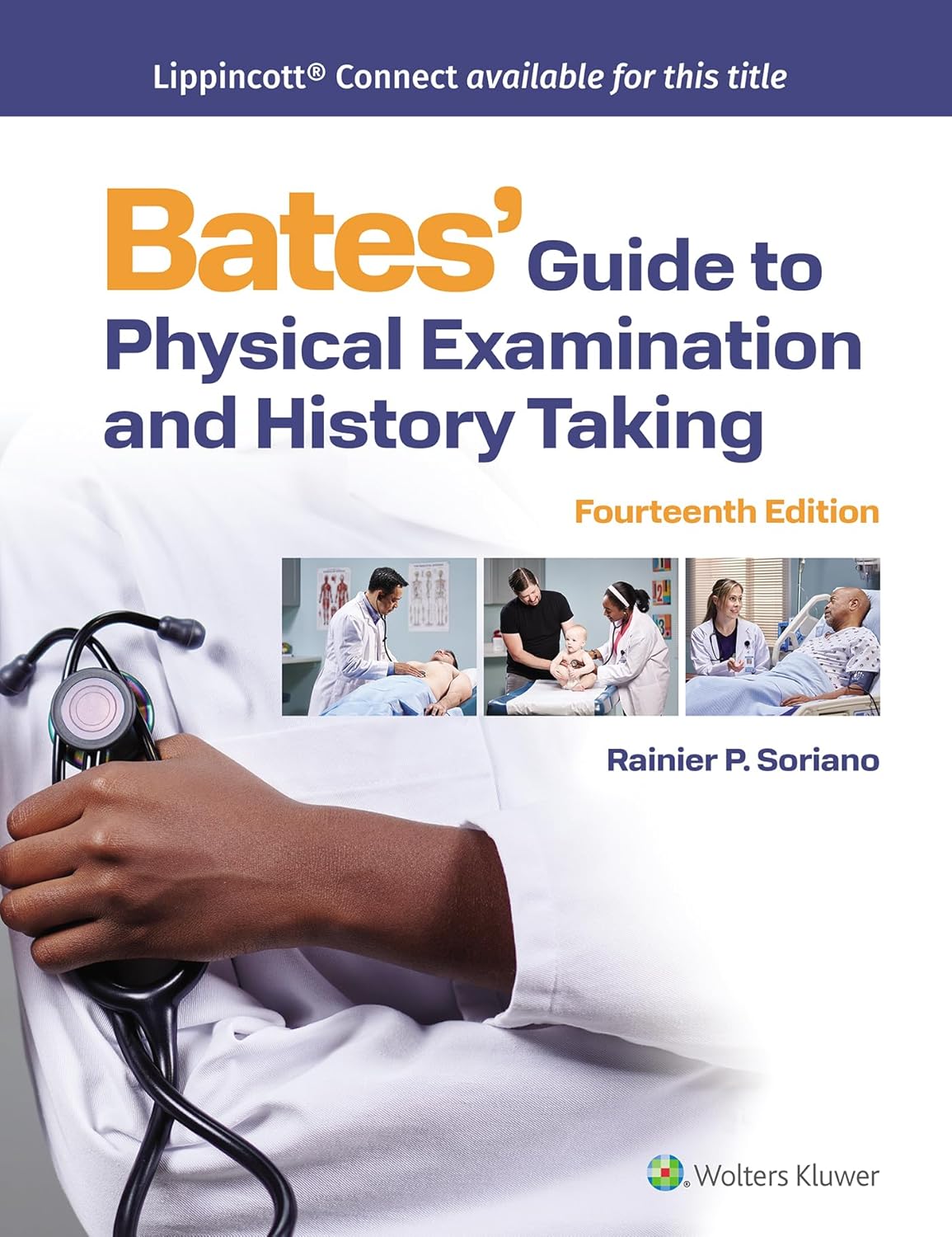
Bates Guide To Physical Examination and History Taking Lippincott Connect 14th Edition
Product details
Publisher : LWW
Publication date : September 24, 2025
Edition : 14th, North American
Language : English
Print length : 1248 pages
ISBN-10 : 1975218345
ISBN-13 : 978-1975218348
Bates Guide to Physical Examination and History Taking 14th Edition — Master the Art of Clinical Assessment
Learning to examine a patient with confidence and precision is one of the most important skills in medicine — and no book teaches it better than the Bates Guide to Physical Examination and History Taking 14th Edition. Now enhanced with Lippincott Connect for seamless digital integration, this legendary title remains the gold standard among medical textbooks for clinical examination skills worldwide.
Whether you are encountering your first patient or refining years of clinical experience, this edition gives you the tools, techniques, and clinical reasoning frameworks to perform thorough, accurate, and compassionate patient assessments every time.
What Does Bates Guide to Physical Examination and History Taking 14th Edition Cover?
This edition provides a comprehensive, system-by-system guide to patient history-taking and physical examination, grounded in the latest clinical evidence and enriched with real patient photography, clinical cases, and visual learning tools throughout.
Coverage across this edition includes:
- Foundations of clinical assessment — the patient interview, communication skills, and health history
- General survey, vital signs, and pain assessment
- Head, eyes, ears, nose, and throat examination
- Cardiovascular and peripheral vascular examination
- Thorax, lungs, and breast examination
- Abdomen, gastrointestinal, and genitourinary systems
- Musculoskeletal examination — joints, bones, gait, and range of motion assessment, essential for learners also using orthopedic surgery books
- Neurological examination — cranial nerves, motor, sensory, and cerebellar testing
- Special populations — examination of children, pregnant patients, and older adults
- Mental health assessment and clinical documentation
The musculoskeletal chapter is one of the most thorough and clinically relevant sections in the book. It covers joint inspection, palpation, special orthopaedic tests, and gait analysis — all directly relevant to rheumatology, physiotherapy, and orthopaedic clinical practice.
Who Should Use Bates Guide to Physical Examination and History Taking 14th Edition?
This is one of those essential clinical medicine books that serves learners at every stage of training. From the first clinical year through to specialist practice, Bates remains a trusted reference for anyone whose work involves assessing patients directly.
Ideal For:
- MBBS students — Considered one of the most important MBBS books for clinical skills training. It bridges the gap between classroom learning and actual patient contact with clarity and confidence.
- Orthopedic trainees — The detailed musculoskeletal examination chapter, covering special tests for the shoulder, knee, spine, and hip, perfectly complements the surgical focus of orthopedic surgery books.
- Rheumatology students — Examination findings for inflammatory arthritis, connective tissue disorders, gout, ankylosing spondylitis, and synovitis are covered with excellent clinical detail and visual support.
- Physiotherapy students — Alongside physiotherapy books, this edition builds the clinical assessment foundation physiotherapists need for movement analysis, musculoskeletal screening, and patient communication.
- Doctors and clinical educators — An authoritative reference for teaching examination technique and a trusted refresher for clinicians returning to practice or preparing for clinical assessments.
Clinical and Educational Benefits
What has always made Bates exceptional among medical textbooks is its focus on the whole patient — not just the disease. It teaches students how to listen, observe, and interpret findings with both scientific rigour and genuine human sensitivity.
Used alongside anatomy books, it brings anatomical structures to life by showing exactly how they present during clinical examination — from the feel of an enlarged lymph node to the sound of a pericardial rub. That integration of structure and clinical sign is something no anatomy atlas alone can fully achieve.
Furthermore, paired with surgery books, it helps surgical trainees develop the pre- and post-operative assessment skills that directly affect patient outcomes. As a core component of any strong set of healthcare education resources, it belongs in every clinical student’s collection.
Practical Learning Advantages
The Lippincott Connect integration in this edition is a genuine upgrade. Students gain access to digital content including instructional videos, interactive clinical cases, and self-assessment tools that reinforce every chapter in an engaging, modern format.
Additionally, the book’s use of full-colour clinical photographs, annotated diagrams, and real-patient images makes it one of the most visually rich learning tools available. Seeing a clubbed finger, a positive Lachman test, or a swan-neck deformity in clear, high-quality photography is worth a thousand words of description.
Key Features of the 14th Edition
What Makes This Edition Outstanding:
- ✅ Lippincott Connect access — videos, digital cases, and interactive assessments included
- ✅ Full-colour clinical photography throughout, including real patient examinations
- ✅ Comprehensive musculoskeletal chapter with orthopaedic special tests and joint assessment
- ✅ Updated clinical evidence and revised examination techniques for 2024 practice
- ✅ Health equity and inclusive care — content updated to reflect diverse patient populations
- ✅ Clinical tips and abnormal findings highlighted throughout each chapter
- ✅ OSCE preparation guidance built naturally into the examination structure
Frequently Asked Questions (FAQs)
Is Bates Guide essential for MBBS students?
Absolutely. It is consistently listed among the most important MBBS books for the clinical phase of training. No other book teaches physical examination technique with the same depth, visual richness, and clinical reasoning emphasis that Bates delivers.
How helpful is it for orthopedic and rheumatology learners?
Extremely helpful. The musculoskeletal and neurological examination chapters cover special orthopaedic tests, joint assessment techniques, and the physical signs of inflammatory and degenerative joint disease in outstanding detail. It pairs perfectly with orthopedic surgery books for trainees building a complete clinical skill set.
Is the book suitable for physiotherapy students?
Yes, it is one of the best complementary resources a physiotherapy student can own. Alongside specialist physiotherapy books, it builds the systematic assessment skills needed for musculoskeletal screening, neurological testing, and effective patient communication in clinical settings.
What does the Lippincott Connect access include?
Lippincott Connect provides online access to instructional examination videos, clinical case studies, and self-assessment tools that complement every chapter of the printed book. It is particularly useful for OSCE preparation and remote or blended learning environments.
Final Thoughts — Order Bates Guide to Physical Examination and History Taking 14th Edition Today
In summary, the Bates Guide to Physical Examination and History Taking 14th Edition is more than a textbook — it is the foundation of every great clinical assessment. It teaches not just technique, but the confidence, precision, and empathy that define truly excellent clinicians. Among all clinical medicine books, few have shaped as many careers as this one.
Whether you are an MBBS student stepping onto the ward for the first time, an orthopedic or rheumatology trainee sharpening your examination technique, a physiotherapy student developing assessment skills, or a doctor revisiting core clinical fundamentals — this edition is the one to have.
Order your copy today and explore our complete range of anatomy books, surgery books, medical textbooks, and trusted healthcare education resources — because great clinical care always begins with a great clinical examination.
Reviews
There are no reviews yet.