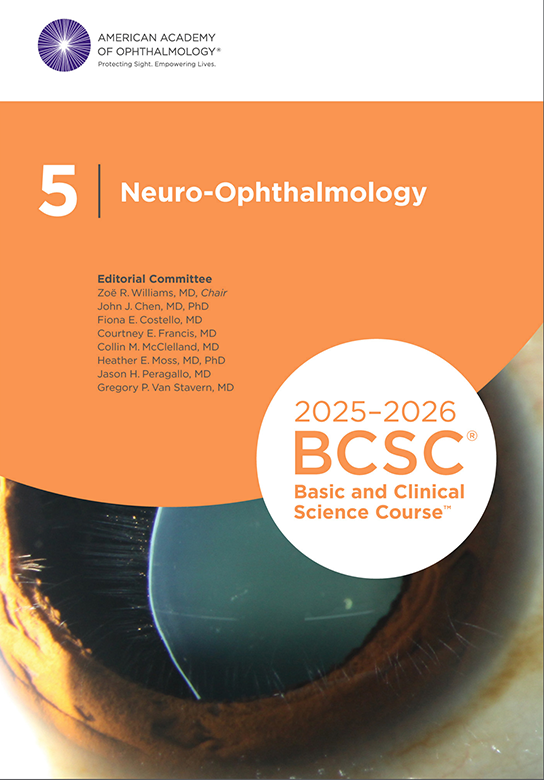
Description
Basic and Clinical Science Course Section 5: Neuro-Ophthalmology
Section 5 of the Academy’s Basic and Clinical Science Course™ (BCSC®) provides a symptom-driven approach to diagnosing and treating major neuro-ophthalmic conditions. Accordingly, the emphasis is on the patient’s examination, both basic and extended, and the appropriate use of adjunctive studies to determine the status of the patient’s visual system.
BCSC Section 5’s major revision features improved content regarding the approach to diagnosing and managing a patient with neuro-ophthalmic disease. BCSC Section 5’s opening chapter, “Neuro-Ophthalmic Anatomy,” has been reorganized, clinical content has been updated, and online neuroimaging correlates to the anatomical illustrations have been added.
Two new features have also been added: underlined “Key Points,” which identify essential information in each chapter, and interactive online case studies in which the reader is prompted to describe the appropriate evaluation of common neuro-ophthalmic problems.
Topics that have been expanded include sagging eye syndrome (age-related distance esotropia and cyclovertical strabismus), foveal displacement syndrome, Wernicke encephalopathy, Guillain-Barré syndrome, Miller Fisher syndrome, and Parkinson disease. The overview of supranuclear (prenuclear) disorders of ocular motility, widely considered one of the most challenging topics in neuro-ophthalmology, has been restructured for a more logical flow and improved readability.
This updated edition includes 19 new videos and three new interactive activities, for a total of 51 videos (sample), and eight activities. In addition, there are three new case studies and nine online labeled anatomy images. Both print and eBook users can access the videos and activities.
Upon completion of Section 5, readers should be able to:
Explain a symptom-driven approach to the assessment of patients with common neuro-ophthalmic clinical manifestations and state an appropriate differential diagnosis
Describe a plan for the immediate management of patients with neuro-ophthalmic emergencies
Describe eye movement disorders and their anatomical relationship to the ocular motor system
Section chair: Zoë R. Williams, MD
Print: 500 pages
eBook: Read Academy eBooks online from nearly any computer, or download eBooks to your mobile device with the free Academy eBooks app. For eBook features, requirements and licensing, visit: aao.org/ebooks. Please allow up to 90 minutes to receive an access key (via email) that will allow you to retrieve your eBook after purchase.
Print ISBN: 978-1681048369 978-1681048369
All content published by the Academy is protected by copyright law and the Terms of Service. This content may not be reproduced, copied, or put into any artificial intelligence program, including large language and generative AI models, without permission from the Academy.
About the BCSC
The Academy’s Basic and Clinical Science Course™ is ophthalmology’s definitive source of clinical information. Practicing ophthalmologists and residents worldwide use the BCSC® to ensure the highest-quality patient care.
Each of the 13 volumes includes up-to-date clinical knowledge, concise text, tables, photos and illustrations, multimedia, self-assessment questions with answers, and opportunities to earn AMA PRA Category 1 Credit™.
Beginning with the 2013–2014 edition, the Academy and the European Board of Ophthalmology (EBO) have partnered to make the BCSC the standard text for all European ophthalmology training programs. The EBO now recommends the BCSC as the primary educational resource for European trainees and ophthalmologists studying for the annual EBO Diploma Exam.
CME Information
The American Academy of Ophthalmology is accredited by the Accreditation Council for Continuing Medical Education (ACCME) to provide continuing medical education for physicians.
The American Academy of Ophthalmology designates this enduring material for a maximum of 15 AMA PRA Category 1 Credits™. Physicians should claim only the credit commensurate with the extent of their participation in the activity.
Reviews
There are no reviews yet.