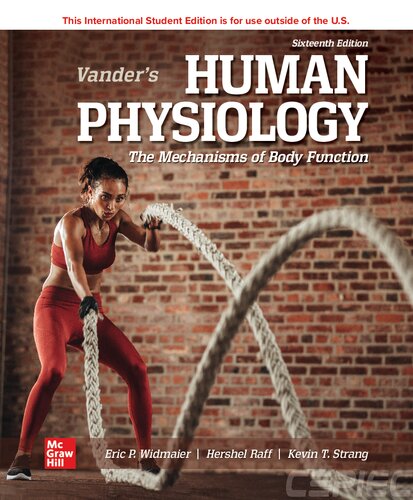
Description
Vanders Human Physiology 16th Edition
Product details
Publisher : McGraw Hill
Publication date : March 7, 2022
Edition : 16th
Language : English
Print length : 576 pages
ISBN-10 : 1265131813
ISBN-13 : 978-1265131814
Vanders Human Physiology 16th Edition A Trusted Research-Driven Physiology Textbook for Modern Medical Education
For decades, Vander’s Human Physiology has stood as one of the most respected names in physiology education — and the Vander’s Human Physiology 16th Edition continues that distinguished legacy with confidence. Known for its emphasis on research, mechanism-based learning, and clinical integration, this edition is a natural choice for students and professionals who want more than surface-level understanding. It does not just tell you what happens in the body — it shows you how and why, with scientific rigour and clarity working hand in hand.
Thoroughly updated to reflect the latest advances in physiology and biomedical science, this sixteenth edition is a compelling addition to any serious medical library. Whether you are studying for exams or building long-term clinical knowledge, this book consistently delivers.
What Does Vander’s Human Physiology 16th Edition Cover?
This comprehensive textbook provides detailed, mechanism-focused coverage of all major physiological systems. Its research-integrated approach makes it especially strong for students who want to understand the science behind clinical medicine.
Core topics covered include:
- Homeostasis, cell structure, and fundamental physiological principles
- Chemical messengers, receptors, and signal transduction pathways
- Neurophysiology — neural communication, sensory systems, and motor control
- Muscle physiology — skeletal, smooth, and cardiac muscle mechanics
- Cardiovascular physiology — cardiac function, blood pressure, and vascular regulation
- Respiratory physiology — breathing control, gas exchange, and lung mechanics
- Renal physiology — filtration, reabsorption, and fluid-electrolyte balance
- Gastrointestinal physiology — digestion, absorption, and gut motility
- Endocrine physiology — hormone synthesis, regulation, and metabolic control
- Immune system physiology, reproductive physiology, and exercise responses
The detailed coverage of musculoskeletal physiology, joint biomechanics, and inflammatory signalling makes this edition an excellent companion to orthopedic surgery books for trainees in surgical and musculoskeletal specialties.
Who Should Use This Book
MBBS and Undergraduate Medical Students
Among the strongest options in the category of MBBS books, Vander’s offers a research-grounded approach that prepares students for the analytical demands of medical school and beyond. Its clear explanations and clinical examples make complex mechanisms genuinely understandable for students at all levels.
Orthopedic and Rheumatology Trainees
Understanding the physiological basis of bone remodelling, synovial joint function, cartilage metabolism, skeletal muscle fatigue, and systemic inflammation is essential in both orthopedics and rheumatology. This textbook addresses all of these topics with the scientific depth that specialty trainees require. It pairs naturally with anatomy books and clinical medicine books to create a well-rounded musculoskeletal knowledge base.
Physiotherapy Students
This is one of the most scientifically thorough physiotherapy books available. The chapters on muscle physiology, neuromuscular transmission, motor unit function, proprioception, and exercise physiology give physiotherapy students the biological grounding needed to deliver evidence-based, effective clinical care.
Practicing Doctors and Healthcare Educators
For clinicians who value research-informed understanding, Vander’s is an exceptionally reliable reference. It integrates seamlessly into any collection of healthcare education resources and is equally useful for postgraduate study, clinical teaching, and continuing professional development.
Clinical and Educational Benefits
What truly distinguishes Vander’s Human Physiology 16th Edition among other medical textbooks is its research-to-clinic pipeline. Each physiological concept is grounded in experimental evidence and then directly connected to clinical application — giving students a scientifically credible and practically useful understanding of how the body functions in health and disease.
Moreover, the book’s consistent focus on mechanism — rather than simple memorization — builds the kind of adaptive clinical reasoning that is increasingly valued in modern medical education and professional licensing assessments. Students who understand the “how” are far better equipped when clinical scenarios change.
Key Features of This Edition
- ✅ Research-integrated content grounded in current biomedical science
- ✅ Mechanism-based explanations that build lasting conceptual understanding
- ✅ High-quality full-colour diagrams, flowcharts, and physiological models
- ✅ Clinical Case Studies in each chapter connecting physiology to real patient scenarios
- ✅ Quantitative reasoning sections for students preparing for research or data-based exams
- ✅ Thorough coverage of immune physiology — including inflammation and autoimmunity
- ✅ Valuable companion to surgery books and evidence-based clinical references
Practical Learning Advantages
One of Vander’s greatest strengths is the way it teaches students to think scientifically about physiology. Rather than presenting the subject as a collection of isolated facts, the book builds interconnected understanding — showing how changes in one system ripple through others. This integrative perspective is particularly valuable for managing multi-system conditions in clinical practice.
When paired with anatomy books, Vander’s creates a powerful dual foundation — structure meets function — that produces stronger diagnostic thinking and more confident clinical performance. Many students report that this combination significantly improves their ability to interpret clinical findings and apply physiological knowledge in patient care settings.
Furthermore, for students building a study library around orthopedic surgery books, the depth of musculoskeletal, neuromuscular, and connective tissue physiology in this edition provides a level of scientific foundation that most comparable physiology texts simply do not offer.
Frequently Asked Questions (FAQ)
Is Vander’s Human Physiology 16th Edition suitable for first-year medical students?
Yes. While it has more scientific depth than some introductory texts, its well-structured chapters and clear writing make it entirely accessible for first-year MBBS and undergraduate medical students. It rewards careful reading with lasting understanding.
What is new in the 16th Edition compared to earlier editions?
The 16th Edition features updated research integration, revised clinical case studies, new content in immune physiology and endocrinology, and refreshed illustrations — ensuring the material reflects the most current understanding in human physiology and biomedical science.
Is this book useful for orthopedic and rheumatology trainees?
Absolutely. The detailed treatment of skeletal muscle physiology, bone metabolism, synovial joint mechanics, cartilage biology, and inflammatory pathways makes Vander’s particularly relevant for trainees in both orthopedics and rheumatology practice.
Can physiotherapy students use Vander’s Human Physiology effectively?
Yes, and many do. The coverage of neuromuscular physiology, proprioception, motor control, muscle fatigue, and exercise-related adaptations aligns strongly with physiotherapy training requirements and clinical practice competencies.
How does Vander’s compare to other physiology textbooks like Berne & Levy or Costanzo?
Vander’s is distinguished by its stronger emphasis on research evidence and mechanism-based learning. While Berne & Levy offers encyclopaedic depth and Costanzo prioritises exam readiness, Vander’s strikes a balance between scientific rigour and clinical application — making it ideal for students who want to understand physiology at a deeper, more analytical level.
Order Vanders Human Physiology 16th Edition and Elevate Your Physiological Understanding
From foundational cellular mechanisms to complex whole-body regulation, Vander’s Human Physiology 16th Edition delivers an intellectually rich, clinically connected, and scientifically credible physiology education that very few other books can match. Whether you are beginning your medical training, preparing for licensing exams, or advancing your specialist knowledge in fields like orthopedics, rheumatology, or physiotherapy — this book gives you the tools to think more deeply and practise more confidently.
It has earned its respected position among the world’s leading medical textbooks, and the 16th edition makes that reputation even stronger. Clear, current, and clinically relevant — this is physiology learning done right.
Add it to your cart today and explore our complete range of MBBS books, clinical medicine books, and healthcare education resources — because investing in the right books is investing in the kind of doctor or clinician you are becoming.
Reviews
There are no reviews yet.