Description
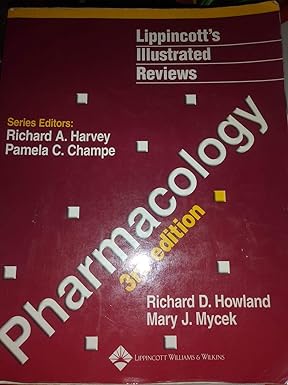
Pharmacology Lippincotts Illustrated Reviews Series 3rd Edition
Product details
Publisher : Lippincott Williams & Wilkins
Publication date : January 1, 2005
Edition : 3rd
Language : English
Print length : 552 pages
ISBN-10 : 0781741181
ISBN-13 : 978-0781741187
Pharmacology Lippincotts Illustrated Reviews Series 3rd Edition – Visual Pharmacology Learning That Builds Clinical Confidence
Some pharmacology textbooks tell you what drugs do. Lippincott’s Illustrated Reviews: Pharmacology 3rd Edition shows you — through full-colour mechanism illustrations that make even the most complex drug actions genuinely easy to understand and remember. Part of the trusted Lippincott’s Illustrated Reviews Series, this edition brought a refreshing visual approach to pharmacology education at a time when the subject was taught almost entirely through dense text. For students and clinicians who learn better by seeing than reading, this book remains one of the most effective pharmacology resources available.
Among the medical textbooks used for pharmacology learning and revision, Lippincott’s Illustrated Reviews stands out consistently for doing what text-heavy alternatives cannot — making mechanisms visually intuitive and clinically memorable.
What Does Lippincott’s Illustrated Reviews: Pharmacology 3rd Edition Cover?
This edition delivers comprehensive pharmacology coverage organised by drug class and body system, making it easy to study in parallel with clinical subjects and physiology. The content covers all major drug classes with an emphasis on mechanisms, therapeutic applications, adverse effects, and clinically important interactions.
Key drug categories covered include:
- General pharmacology — pharmacokinetics, pharmacodynamics, drug metabolism, and drug-receptor interactions
- Autonomic pharmacology — cholinergic, adrenergic, and related agents with receptor-level mechanism illustrations
- Central nervous system drugs — antidepressants, antipsychotics, anxiolytics, sedative-hypnotics, analgesics, and anaesthetics
- Cardiovascular pharmacology — antihypertensives, antiarrhythmics, heart failure drugs, anticoagulants, and lipid-lowering agents
- Renal pharmacology — diuretics and their mechanisms of action in different tubular segments
- Anti-inflammatory and analgesic drugs — NSAIDs, corticosteroids, DMARDs, and disease-modifying agents relevant to rheumatology and orthopedic practice
- Antimicrobial pharmacology — antibiotics, antivirals, antifungals, and antiparasitic agents classified by mechanism
- Endocrine pharmacology — insulin, thyroid agents, adrenal drugs, and hormonal therapies
- Chemotherapy and immunosuppressant drugs — highly relevant for oncology and rheumatology treatment contexts
- Respiratory, gastrointestinal, and haematological pharmacology
The anti-inflammatory, corticosteroid, DMARD, and biologic sections make this edition particularly useful alongside orthopedic surgery books and for students entering rheumatology, where understanding drug mechanisms is inseparable from understanding treatment decisions.
Who Should Use Lippincott’s Illustrated Reviews: Pharmacology?
This book serves a wide range of learners across medical and allied health education. It is especially well-suited for:
- MBBS students in their pharmacology module who want a visually driven resource to complement the rest of their MBBS books — particularly those who find traditional text-heavy pharmacology texts difficult to engage with
- Physiotherapy students who need a strong understanding of drugs commonly used in musculoskeletal, pain management, and neuromuscular clinical contexts — it pairs naturally with your physiotherapy books
- Orthopedic trainees who want to understand the pharmacological basis of pain management, bone metabolism drugs, surgical prophylaxis, and perioperative pharmacology
- Rheumatology students and residents for whom DMARDs, biologics, corticosteroids, NSAIDs, and immunosuppressants are central to clinical practice
- Doctors and general practitioners who want a reliable, visually clear pharmacology reference alongside their clinical medicine books
- Anyone building a well-rounded library of healthcare education resources that covers drug mechanisms with visual clarity
Clinical and Educational Benefits
Illustrations That Make Mechanisms Click
The most powerful feature of Lippincott’s Illustrated Reviews: Pharmacology is its use of full-colour mechanism diagrams throughout every chapter. Drug-receptor interactions, ion channel effects, enzyme inhibition, second messenger cascades — all of these are illustrated in a way that transforms abstract biochemistry into visual memory. Once you have seen a mechanism illustrated this clearly, it is genuinely difficult to forget.
This visual strength makes it an excellent complement to anatomy books and surgery books where understanding what a drug does to a tissue or organ in context significantly enhances clinical and surgical thinking.
Clinically Oriented From Start to Finish
Throughout each chapter, pharmacological content is consistently linked to clinical applications — therapeutic uses, contraindications, drug interactions, and adverse effects are all presented with the clinician’s perspective in mind. This orientation makes it directly useful for ward-based learning, clinical posting preparation, and professional examination revision.
Strong Foundation for Orthopedic and Rheumatology Pharmacology
The anti-inflammatory pharmacology section is particularly valuable — covering NSAIDs, COX inhibitors, corticosteroids, and the rationale behind disease-modifying therapy in inflammatory conditions. For orthopedic trainees, the sections on analgesics, bisphosphonates, and bone metabolism drugs are directly relevant. For rheumatology learners, the immunosuppressant and biologic agent sections provide a mechanistic foundation for understanding complex treatment regimens.
Practical Learning Advantages
This edition is practical in the best sense — easy to navigate, visually engaging, and structured to support both new learning and focused revision:
- Full-colour drug mechanism illustrations throughout every chapter
- Drug class organisation that mirrors how pharmacology is taught and examined
- Adverse effect and drug interaction highlights clearly presented for each drug class
- Chapter review questions for self-assessment and exam preparation
- Concise chapter summaries allowing fast, targeted revision of any drug class
- Accessible language that balances scientific accuracy with readability
Key Features of Lippincott’s Illustrated Reviews: Pharmacology 3rd Edition
- ✅ Comprehensive pharmacology coverage organised by drug class and body system
- ✅ Full-colour mechanism illustrations for every major drug class throughout
- ✅ Clinically oriented content covering therapeutic use, adverse effects, and drug interactions
- ✅ Strong anti-inflammatory, DMARD, and analgesic coverage for orthopedic and rheumatology learners
- ✅ Chapter review questions and summaries for examination preparation
- ✅ Natural complement to MBBS books and clinical rotation preparation
- ✅ Part of the trusted Lippincott’s Illustrated Reviews Series with a proven track record in pharmacology education
- ✅ Useful alongside clinical medicine books and specialty pharmacology references
Frequently Asked Questions (FAQ)
Is the 3rd Edition still relevant for MBBS students today?
Yes. The core pharmacological principles, drug mechanisms, and drug class content covered in the 3rd Edition remain accurate and educationally sound. While newer editions include updated drug entries and revised clinical correlations, the foundational pharmacology — receptor physiology, mechanism diagrams, and drug class organisation — is largely stable. For students primarily focused on understanding mechanisms rather than the very latest drug approvals, the 3rd Edition remains a genuinely useful learning resource.
How does this differ from the newer editions of the same book?
Newer editions of Lippincott’s Illustrated Reviews Pharmacology include updated drug information, additional newer drug classes, and revised clinical correlations. However, the core structure, visual approach, and drug mechanism content are consistent across editions. The 3rd Edition offers all the foundational visual learning that made this series famous — at a more accessible price point than current editions.
Is Lippincott’s Illustrated Reviews useful for physiotherapy students?
Very much so. Physiotherapy students benefit particularly from the analgesic, anti-inflammatory, neuromuscular, and cardiovascular pharmacology sections — all of which are highly relevant to clinical physiotherapy practice. The visual mechanism format is also easier to engage with during busy placement periods than dense text-based pharmacology texts. It complements your physiotherapy books with practical, clinically grounded drug knowledge.
Why is this book particularly useful for rheumatology learners?
The anti-inflammatory drug chapters — covering NSAIDs, corticosteroids, DMARDs, and immunosuppressants — are among the most clearly explained sections in the book. For rheumatology students, understanding not just which drugs are used but precisely how they work at a receptor and cellular level is essential for both examination performance and clinical practice. This book provides exactly that mechanistic clarity.
Can this be used alongside a comprehensive pharmacology textbook?
Absolutely — and for most students, that combination produces the best results. Use a full pharmacology textbook for initial in-depth learning, then use Lippincott’s Illustrated Reviews to reinforce mechanisms visually and revise efficiently before examinations. The two approaches complement each other directly, with the illustrations in this book making the written content of larger medical textbooks significantly easier to retain.
Final Verdict – Why Lippincott’s Illustrated Reviews: Pharmacology 3rd Edition Still Earns Its Place on Your Shelf
Pharmacology does not have to be the subject that defeats you — and Lippincott’s Illustrated Reviews: Pharmacology 3rd Edition makes a compelling case for why visual learning is the most effective approach to mastering it. The drug mechanisms, the clinical orientation, and the structured format all combine to create a pharmacology learning experience that is genuinely different from reading dense text alone.
Whether you are completing your set of MBBS books, building a well-rounded collection of healthcare education resources, or looking for a visual pharmacology companion to your surgery books and clinical medicine books — this edition delivers proven educational value at every stage of medical training.
Order Lippincott’s Illustrated Reviews: Pharmacology 3rd Edition today and discover why visual mechanism learning has made this series a lasting favourite in pharmacology education worldwide.
Reviews
There are no reviews yet.