Description
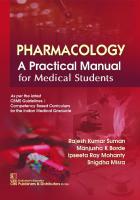
Pharmacology A Practical Manual for Medical Students 1st Edition
Pharmacology A Practical Manual for Medical Students 1st Edition – Hands-On, Lab-Ready Pharmacology Learning for the Modern Medical Student
Theory alone is never enough in medical education — and pharmacology is no exception. Pharmacology A Practical Manual for Medical Students 1st Edition fills a gap that most standard pharmacology texts leave wide open: it bridges the classroom and the laboratory by providing structured, practical, experiment-based pharmacology learning in a single dedicated manual. Designed specifically for undergraduate medical students navigating their pharmacology practical sessions, this first edition delivers clear protocols, applied drug knowledge, and clinically relevant exercises that turn abstract pharmacological concepts into tangible, memorable understanding.
For students who want to do more than read about pharmacology — who want to see it, measure it, and apply it — this practical manual is an essential addition to their medical education toolkit.
What Does Pharmacology A Practical Manual for Medical Students Cover?
This manual is built around the practical pharmacology curriculum that undergraduate medical students encounter in their laboratory and experimental sessions. It provides structured guidance for pharmacology practicals, experimental procedures, drug calculations, and applied clinical pharmacology — all in a clear, step-by-step format that is easy to follow in a lab setting.
Key areas covered include:
- General pharmacology practicals — dose-response relationships, drug receptor interactions, and experimental design
- Pharmacokinetics experiments — absorption, distribution, metabolism, and excretion demonstrations
- Autonomic pharmacology practicals — experiments involving cholinergic, adrenergic, and neuromuscular agents
- Cardiovascular pharmacology — experimental observations of cardiac and vascular drug effects
- Smooth muscle pharmacology — experiments on bronchial, intestinal, and uterine smooth muscle responses
- CNS pharmacology practicals — sedation, analgesia, and anticonvulsant drug experiments
- Musculoskeletal pharmacology — skeletal muscle relaxants, anti-inflammatory drug experiments, and neuromuscular studies
- Drug calculations — dosage computation, prescription writing, and clinical dose adjustment exercises
- Prescription writing and over-the-counter drug identification practicals
- Clinical case-based pharmacology scenarios for applied learning
The musculoskeletal pharmacology practicals — including experiments with skeletal muscle relaxants, anti-inflammatory agents, and neuromuscular blocking studies — are particularly relevant for students who also use orthopedic surgery books and want a practical pharmacological grounding in musculoskeletal drug management.
Who Should Use This Book?
MBBS and Undergraduate Medical Students
This manual is an essential practical companion within the category of MBBS books — particularly for students in their second year when pharmacology practicals form a core component of the curriculum. It provides the structured, experiment-ready guidance that students need to approach lab sessions with confidence and extract the maximum educational value from each practical session.
Orthopedic and Rheumatology Trainees
For trainees who want to reinforce the pharmacological basis of musculoskeletal medicine — including anti-inflammatory drug mechanisms, neuromuscular pharmacology, and analgesic drug actions — the experimental and applied content in this manual provides a foundational practical perspective that complements anatomy books and clinical medicine books used in specialty training.
Physiotherapy Students
For those looking for physiotherapy books with a practical pharmacology dimension, this manual offers physiotherapy students clear, applied coverage of muscle relaxant pharmacology, pain management drug experiments, and anti-inflammatory agent studies — all of which connect directly to the pharmacological context of physiotherapy clinical practice.
Practicing Doctors and Healthcare Educators
For clinicians involved in undergraduate pharmacology teaching, this manual is a reliable, structured resource for planning and delivering practical sessions. It integrates naturally into broader healthcare education resources used in medical college laboratory programmes and pharmacology teaching departments.
Clinical and Educational Benefits
What makes Pharmacology A Practical Manual for Medical Students 1st Edition genuinely different from other medical textbooks is its exclusive focus on the practical, applied dimension of pharmacology education. While most pharmacology texts explain drug mechanisms theoretically, this manual puts those mechanisms into experimental context — helping students understand not just what a drug does, but how that effect is observed, measured, and interpreted in a controlled setting.
Furthermore, the drug calculation and prescription writing sections provide the kind of applied clinical pharmacology training that directly prepares students for real prescribing responsibilities — a skill that is increasingly prioritised in modern undergraduate medical curricula and licensing frameworks worldwide.
Key Features of This Edition
- ✅ Structured practical protocols for all major pharmacology laboratory sessions
- ✅ Step-by-step experimental procedures with expected observations and interpretations
- ✅ Drug calculation exercises and clinical dosage adjustment practice
- ✅ Prescription writing and drug identification practicals included
- ✅ Clinical case scenarios connecting practical pharmacology to patient care
- ✅ Clear diagrams and observation tables for organised lab record keeping
- ✅ Practical companion to surgery books and clinical pharmacology references
Practical Learning Advantages
One of the most significant advantages of this manual is how it transforms the pharmacology practical session from a routine requirement into a genuine learning opportunity. With clear protocols, guided observations, and interpretive questions built into each practical, students are actively engaged in understanding drug effects — not just mechanically following procedures.
When used alongside anatomy books and a core pharmacology text, this manual creates a complete pharmacology learning ecosystem — theoretical understanding reinforced by structural knowledge and then applied through experimental practice. That three-layer approach produces the kind of deep, durable pharmacological understanding that benefits students long after their examination results are posted.
Furthermore, for students who are also working through orthopedic surgery books, the practical coverage of neuromuscular agents, skeletal muscle relaxants, and anti-inflammatory drug experiments in this manual provides a hands-on pharmacological dimension that gives surgical and musculoskeletal clinical training a stronger scientific foundation.
Frequently Asked Questions (FAQ)
Is this manual suitable for all MBBS students doing pharmacology practicals?
Yes, absolutely. It is designed specifically for undergraduate medical students in their pharmacology practical years and follows the standard practical pharmacology curriculum. Its structured format and clear protocols make it useful for students at all levels of practical experience.
Does this manual replace a standard pharmacology textbook?
No — and it is not designed to. This is a dedicated practical companion meant to be used alongside a core pharmacology text. Together, they provide complete pharmacology education: theory from the textbook, application and experimental understanding from this manual.
Is it helpful for students preparing for pharmacology viva examinations?
Yes. The clinical case scenarios, observation interpretations, and applied drug calculation exercises are particularly useful for viva preparation — helping students articulate drug effects, experimental findings, and pharmacological reasoning with confidence and clarity.
Can physiotherapy students use this manual?
Yes, particularly those in programmes that include a pharmacology practical component. The muscle relaxant, anti-inflammatory, and analgesic drug experiments are directly relevant to physiotherapy pharmacology requirements.
Is this manual relevant for orthopedic and rheumatology trainees?
While primarily designed for undergraduates, the practical pharmacology content — including neuromuscular agent experiments, anti-inflammatory drug studies, and musculoskeletal pharmacology exercises — provides a useful foundational reference for early-stage orthopedic and rheumatology trainees who want to understand the experimental basis of the drugs they use clinically.
Order Pharmacology A Practical Manual for Medical Students 1st Edition and Master the Applied Side of Drug Science
Pharmacology is not just something you read — it is something you learn by doing. The Pharmacology A Practical Manual for Medical Students 1st Edition gives you the structured, experiment-based, clinically grounded pharmacology education that textbooks alone cannot deliver. From drug calculations to experimental observations and prescription writing, this manual prepares you for every aspect of your pharmacology practical assessment and beyond.
It stands in a category of its own among medical textbooks and practical learning tools — a dedicated, purpose-built resource for the applied dimension of undergraduate pharmacology education that every MBBS student deserves to have.
Add it to your cart today and explore our complete range of MBBS books, clinical medicine books, and healthcare education resources — because complete pharmacology education means mastering both the theory and the practice.
Reviews
There are no reviews yet.