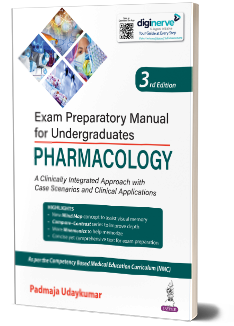
Description
Exam Preparatory Manual for Undergraduates Pharmacology 3rd Edition
| Author | Author’s Affiliation |
|---|---|
| 1. Udaykumar Padmaja | Father Muller Medical College, Mangaluru, Karnataka, India Father Muller Medical College Hospital, Mangaluru, Karnataka, India |
| ISBN | 9789356966338 |
| Speciality | Pharmacology, Pharmacology |
| DOI | 10.5005/jp/books/18934 |
| Edition | 3/e Reprint |
| Publishing Year | 2025 |
| Pages | 620 |
| Book Type | Textbook |
Exam Preparatory Manual for Undergraduates Pharmacology 3rd Edition – The Complete Question-and-Answer Pharmacology Guide Built for MBBS Exam Success
Pharmacology examinations at the undergraduate level test not just what you know — but how well you can present that knowledge under pressure, in the right format, at the right depth. The Exam Preparatory Manual for Undergraduates Pharmacology 3rd Edition is built precisely around that reality. Designed as a comprehensive question-and-answer study guide for MBBS students, this edition covers the entire undergraduate pharmacology syllabus through structured exam-style questions, model answers, and clinical notes — making it one of the most targeted and practically effective pharmacology preparation resources available for South Asian medical students.
Whether you are building topic-by-topic understanding during the semester or entering your final revision sprint before professional examinations, this third edition delivers everything you need to prepare with confidence and write answers that examiners actually reward.
What Does the Exam Preparatory Manual for Undergraduates Pharmacology 3rd Edition Cover?
This manual covers the complete undergraduate pharmacology curriculum through a question-and-answer format, organised by drug system and topic. Every major pharmacological area is addressed with clear model answers that reflect the depth, structure, and clinical application expected in university examinations.
Key topics and drug systems covered include:
- General pharmacology — pharmacokinetics, pharmacodynamics, drug interactions, tolerance, and dependence
- Autonomic pharmacology — adrenergic agents, cholinergic drugs, ganglionic blockers, and neuromuscular blocking agents
- Central nervous system pharmacology — opioid analgesics, sedative-hypnotics, antiepileptics, antidepressants, antipsychotics, and general anaesthetics
- Cardiovascular pharmacology — antihypertensives, antiarrhythmics, anticoagulants, antiplatelets, and cardiac glycosides
- Respiratory pharmacology — bronchodilators, inhaled corticosteroids, expectorants, and antihistamines
- Musculoskeletal pharmacology — NSAIDs, corticosteroids, DMARDs, biologic agents, skeletal muscle relaxants, and anti-gout drugs
- Endocrine pharmacology — insulin formulations, oral antidiabetics, thyroid agents, adrenal drugs, and sex hormones
- Antimicrobial pharmacology — antibiotic classification, antifungals, antivirals, antiparasitic agents, and resistance mechanisms
- Chemotherapy, immunosuppressants, and GIT pharmacology
- Prescription writing, adverse drug reactions, and drug regulatory concepts
The musculoskeletal pharmacology section — covering NSAIDs, disease-modifying antirheumatic drugs, corticosteroid therapy, and biologic treatments — makes this a valuable pharmacological companion to orthopedic surgery books for students preparing for clinical rotations in surgical and musculoskeletal disciplines.
Who Should Use This Book?
MBBS and Undergraduate Medical Students
This manual is one of the most examination-aligned titles in the entire range of MBBS books for pharmacology. Its question-and-answer structure mirrors exactly how university examinations test pharmacological knowledge — making it indispensable for students who want to move beyond passive reading and develop the active answer-writing skills that professional pharmacology papers require.
Orthopedic and Rheumatology Trainees
For trainees who want a structured, examination-style review of musculoskeletal pharmacology — including anti-inflammatory drug selection, DMARD protocols, perioperative analgesia, bone-modifying therapies, and corticosteroid management — this manual delivers that content in a revision-ready format. It pairs effectively with anatomy books and clinical medicine books for a comprehensive musculoskeletal training foundation.
Physiotherapy Students
Among the most practically useful physiotherapy books for pharmacology assessment preparation, this edition’s structured question-and-answer format helps physiotherapy students practise articulating their knowledge of analgesic pharmacology, muscle relaxant mechanisms, anti-inflammatory drugs, and cardiovascular agents in the way academic assessments demand.
Practicing Doctors and Healthcare Educators
Clinicians preparing for postgraduate pharmacology assessments, or educators seeking a well-structured undergraduate pharmacology question bank for teaching support, will find this edition highly practical. It integrates naturally into comprehensive healthcare education resources used in pharmacology teaching departments and examination preparation programmes.
Clinical and Educational Benefits
What makes the Exam Preparatory Manual for Undergraduates Pharmacology 3rd Edition stand apart from other medical textbooks in the pharmacology category is its dual function — it teaches pharmacology while simultaneously training students how to write pharmacology examinations. The model answers are not just correct; they are structured, clinically anchored, and formatted to the standards that university examiners look for when awarding marks.
Furthermore, the clinical application notes integrated into key answers help students connect pharmacological mechanisms to real patient management scenarios — building the kind of applied understanding that distinguishes genuinely strong examination candidates from those who have simply memorised facts without context.
Key Features of This Edition
- ✅ Complete undergraduate pharmacology syllabus covered in question-and-answer format
- ✅ Model answers structured to examination marking standards — not just correct, but examiner-ready
- ✅ Updated content in the 3rd edition reflecting revised drug classifications and clinical guidelines
- ✅ Prescription writing questions and model answers included throughout
- ✅ Clinical application notes embedded within key pharmacology topics
- ✅ Organised by drug system for focused, efficient topic-by-topic revision
- ✅ Reliable exam preparation companion to surgery books and clinical pharmacology references
Practical Learning Advantages
One of the most underappreciated aspects of examination preparation is answer-writing skill. Many students understand pharmacology well but lose marks because they cannot organise and present their knowledge in the structured, clinical format examiners reward. This manual trains that skill directly — by showing students not just what the correct content is, but how it should be written for maximum examination impact.
When used alongside anatomy books and a core pharmacology textbook, this manual completes a preparation strategy that covers conceptual understanding, structural context, and examination writing ability in a single integrated approach. That combination is one of the most effective pharmacology preparation strategies available for MBBS students facing professional examinations.
Furthermore, for students concurrently working through orthopedic surgery books, the musculoskeletal pharmacology questions in this manual — covering perioperative pain management, antibiotic prophylaxis, anti-inflammatory prescribing, and DMARD use — provide examination-level pharmacological preparation that directly complements surgical clinical training and pharmacological knowledge requirements.
Frequently Asked Questions (FAQ)
Is the Exam Preparatory Manual for Undergraduates Pharmacology 3rd Edition suitable for MBBS professional examinations?
Absolutely. It is designed specifically for undergraduate professional pharmacology examinations and aligns closely with the question formats, expected answer depth, and clinical context that South Asian university pharmacology papers consistently test. It is one of the most examination-aligned pharmacology preparation resources available.
How does the 3rd edition differ from the 2nd edition?
The 3rd edition includes updated drug classifications, revised clinical application notes reflecting current pharmacological practice, additional questions in high-frequency examination topics, and improved model answer structures — making it a more comprehensive and examination-relevant resource than previous editions.
Can this manual be used as a standalone pharmacology resource?
It works best alongside a core pharmacology textbook. Students should build their pharmacological understanding from a primary text and then use this manual to practice presenting that knowledge in the examination format. Together, they provide a complete and highly effective preparation system.
Is this useful for rheumatology and orthopedic trainees revisiting pharmacology?
Yes. The structured model answers covering musculoskeletal pharmacology, anti-inflammatory therapy, DMARD management, analgesic selection, and corticosteroid use provide a clear, examination-depth review of the drug knowledge most relevant to orthopedic and rheumatology clinical practice at the foundation training level.
Can physiotherapy students benefit from this question-and-answer format?
Definitely. Physiotherapy students facing written pharmacology assessments will find the structured question-and-answer format particularly valuable for practising how to present drug knowledge accurately, clinically, and at the depth their academic assessors expect.
Order the Exam Preparatory Manual for Undergraduates Pharmacology 3rd Edition and Write Pharmacology Answers That Win Marks
Understanding pharmacology is necessary — but writing it well is what actually earns marks in university examinations. The Exam Preparatory Manual for Undergraduates Pharmacology 3rd Edition trains both skills simultaneously, giving MBBS students a pharmacology preparation resource that is as focused on examination performance as it is on pharmacological knowledge. It is thorough, clinically relevant, examination-aligned, and genuinely built for the way South Asian pharmacology papers are written and marked.
It stands as one of the most examination-focused pharmacology medical textbooks available for undergraduate medical students — and the third edition is the strongest version yet.
Add it to your cart today and explore our full range of MBBS books, clinical medicine books, and healthcare education resources — because in pharmacology examinations, how you write your answer matters just as much as what you know.
Reviews
There are no reviews yet.