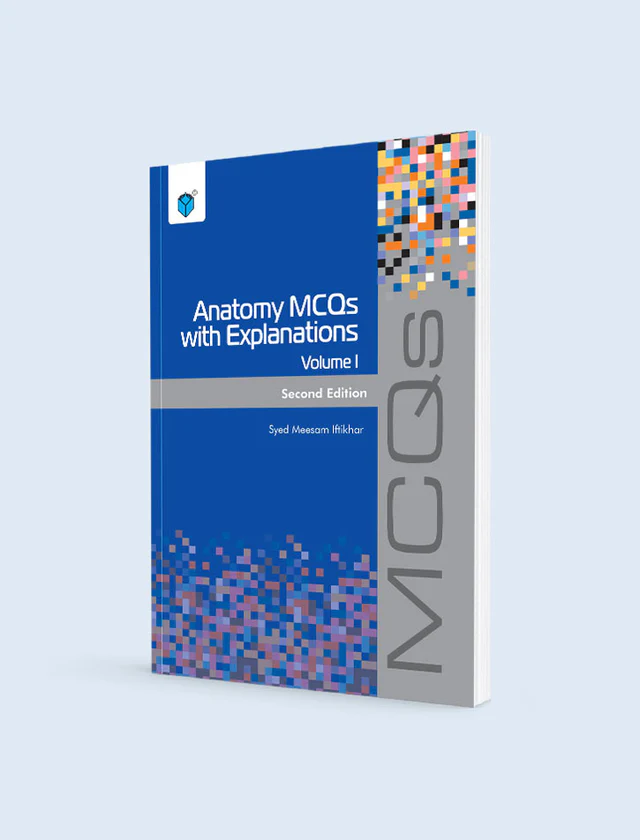
Description
Anatomy Mcqs With Explanations VOL I 2nd Edition
| Author: | SYED MEESAM IFTIKHAR |
| ISBN: | 9789692109598 |
| Publisher: | PARAMOUNT BOOKS (PVT) LTD. |
| Category: | MEDICAL BOOKS | ANATOMY | MEDICAL BOOKS |
| Series: | MCQ’S SERIES |
| Level: | MBBS 1st and 2nd Yr | BDS 1st Yr |
| Book Cover: | Paperback |
| Pages: | 248 |
| Edition: | 2 |
Anatomy MCQs With Explanations Vol I 2nd Edition — Build a Rock-Solid Anatomy Foundation Through Active Practice
Anatomy is the gateway subject of medical education. Master it early, and everything that follows — physiology, pathology, surgery, and clinical medicine — becomes easier to understand and apply. The Anatomy MCQs With Explanations Vol I 2nd Edition gives you a focused, question-driven way to test and strengthen your anatomy knowledge, one system at a time.
Whether you are preparing for your first-year university exams, a licensing assessment, or simply want to ensure your foundational knowledge is genuinely solid, this book delivers exactly the kind of active self-assessment that produces real results.
What Is Anatomy MCQs With Explanations Vol I 2nd Edition?
This book is a dedicated multiple-choice question resource for anatomy — one of the most essential subjects covered in any collection of anatomy books for medical and allied health students. The second edition has been refined and expanded to offer better question quality, clearer explanations, and improved alignment with current examination standards.
Unlike passively reading an anatomy atlas or textbook, working through MCQs with detailed explanations forces you to engage actively with the material. That engagement is what turns short-term memorization into long-term retention — and retention is what gets you through exams and into clinical practice ready to perform.
What Does This Book Cover?
Volume I covers the foundational anatomical regions and systems that form the core of first and second-year medical education. Topics include:
- Upper limb anatomy — bones, joints, muscles, nerves, and vessels of the shoulder, arm, forearm, and hand
- Lower limb anatomy — hip, thigh, knee, leg, and foot structures with clinical correlations
- Thorax — thoracic wall, lungs, heart, mediastinum, and great vessels
- Abdomen — abdominal wall, peritoneum, GI tract, liver, spleen, pancreas, and kidneys
- Pelvis and perineum — pelvic organs, pelvic floor, and reproductive anatomy
- Head and neck — cranial nerves, neck triangles, salivary glands, and orbital structures
- Neuroanatomy essentials — brain regions, spinal cord, and peripheral nervous system
- Surface and clinical anatomy — anatomical landmarks relevant to clinical examination and procedures
- General anatomy — planes, terms of movement, fascia, and tissue types
The upper and lower limb sections are especially relevant when studied alongside orthopedic surgery books, making this one of the most practically useful anatomy books for students entering surgical and musculoskeletal specialties.
Who Should Use This Book?
For MBBS Students in Early Years
First- and second-year MBBS students preparing for anatomy practical and written examinations will find this book an indispensable part of their MBBS books collection. The MCQ format mirrors what most university and licensing exams use, making it excellent preparation for the actual assessment format you will face.
For Physiotherapy Students
Anatomy is foundational to physiotherapy — from understanding joint mechanics and muscle function to planning rehabilitation after injury or surgery. This book complements physiotherapy books by offering structured self-assessment across the anatomical content most relevant to physiotherapy practice, particularly in the limbs and musculoskeletal system.
For Orthopedic and Surgical Trainees
Postgraduate trainees in orthopedics, trauma, or general surgery who want to revisit anatomical knowledge for fellowship exams or board preparation will find this a concise and efficient revision resource. It pairs naturally with orthopedic surgery books and surgery books to reinforce the anatomical basis of operative procedures and clinical decision-making.
For Rheumatology Trainees
Rheumatology trainees dealing with joint and connective tissue diseases benefit from strong anatomical grounding. Understanding the precise anatomy of joints, bursae, tendons, and surrounding structures helps explain clinical findings and guides accurate examination — making this a smart complement to clinical medicine books in this specialty.
For Doctors and Clinicians Revisiting Anatomy
Practicing doctors who want to revisit anatomy for teaching, procedural work, or specialist examinations will find the MCQ-with-explanation format an efficient and intellectually engaging way to refresh their knowledge without working through a full textbook from scratch.
Clinical and Educational Benefits
The MCQ-with-explanation format used in this book is one of the most educationally effective study methods available. Each question challenges you to recall and apply anatomical knowledge rather than simply recognize it — a crucial distinction when exam pressure is high.
Furthermore, the explanations do not just tell you the right answer. They explain the anatomical reasoning behind it, helping you build genuine understanding rather than surface-level recall.
Working through this book consistently will help you:
- Identify anatomical knowledge gaps across all major body regions before your exam
- Understand the clinical relevance of anatomical structures and their relationships
- Connect structural knowledge with pathological and surgical applications in your surgery books
- Strengthen your performance on USMLE Step 1, university anatomy papers, and clinical assessments
- Build the foundational knowledge that supports everything you will study in your clinical medicine books
Practical Learning Advantages
One of the smartest ways to use this book is in direct parallel with your primary anatomy textbook or atlas. Study a region, then immediately test yourself with the corresponding MCQs here. The questions will quickly reveal whether your understanding is deep enough — or whether you need another pass through the material before moving on.
This targeted, feedback-driven approach saves significant revision time compared to re-reading entire chapters repeatedly. It also builds the kind of quick anatomical recall that is essential during clinical examinations, surgical procedures, and OSCEs.
The book integrates naturally into any set of healthcare education resources for preclinical students and serves as a highly practical bridge between foundational anatomy learning and clinical application.
Key Features
- ✅ Comprehensive MCQ coverage of all major anatomical regions in Volume I
- ✅ Detailed explanations for every answer — teaching the reasoning, not just the result
- ✅ Updated 2nd edition with improved question quality and clarity
- ✅ Strong upper and lower limb coverage with clinical and surgical correlations
- ✅ Suitable for MBBS, physiotherapy, postgraduate, and licensing exam preparation
- ✅ Organized by region for focused, flexible, and efficient self-assessment
- ✅ Complements all major anatomy atlases and anatomy books in current use
Frequently Asked Questions (FAQ)
Q: Is this book suitable for USMLE Step 1 anatomy preparation?
Yes. While it is useful for university-level anatomy exams in any medical curriculum, the MCQ format and clinical correlations align well with USMLE Step 1 anatomy content, making it a valuable addition to any Step 1 preparation toolkit.
Q: Does the book cover neuroanatomy?
Yes. Neuroanatomy essentials — including brain regions, spinal cord organization, cranial nerves, and peripheral nerves — are included within Volume I, making it a well-rounded single resource for foundational anatomy self-assessment.
Q: Can physiotherapy students use this book effectively
Absolutely. Physiotherapy students need strong anatomy knowledge — particularly of the musculoskeletal system, joints, and peripheral nerves. The upper and lower limb sections of this book are especially relevant and pair directly with physiotherapy books used in most physiotherapy programs.
Q: How does this compare to simply reading an anatomy textbook?
Reading an anatomy textbook builds knowledge. This book tests whether that knowledge has been genuinely understood and retained. Both are essential — use your primary anatomy books to learn the material, and use this MCQ resource to confirm and consolidate your understanding.
Q: Is Volume I sufficient on its own, or do I need Volume II as well?
Volume I provides comprehensive coverage of the major anatomical regions listed in its content. For complete anatomy MCQ practice across all topics, Volume II serves as the ideal companion — and together they form one of the most complete self-assessment sets among medical textbooks for anatomy.
Conclusion — Strengthen Your Anatomy Knowledge with MCQs With Explanations Vol I 2nd Edition
The Anatomy MCQs With Explanations Vol I 2nd Edition is one of the most effective and practical anatomy self-assessment resources available to medical and allied health students today. With comprehensive regional coverage, clinically informed explanations, and a question format that builds real understanding — not just exam technique — it gives you the anatomical foundation that every aspect of your medical career will rest upon.
Whether you are an MBBS student approaching your anatomy paper, a physiotherapy student building musculoskeletal knowledge, an orthopedic trainee revising for fellowship exams, or a doctor refreshing clinical anatomy — this book delivers focused, honest self-assessment that makes a genuine difference.
Order your copy today and start building the anatomy knowledge your exams — and your patients — will depend on.
Reviews
There are no reviews yet.